

I was recently reviewing the local market data when a particular Instagram reel came across my feed. The video perfectly encapsulated a conversation I’ve been having behind closed doors with almost all of my clients this year. It highlighted the stark contrast between buying a flawless, move-in-ready home versus taking on a property that needs substantial vision and renovation.
Watching it, I couldn’t help but notice how dramatically our collective definition of “luxury” has evolved in Los Angeles. A decade ago, luxury was purely about raw square footage and securing the most exclusive zip codes, even if it meant spending two years in permit purgatory to build out your dream home. Today, we’re seeing a profound shift. True luxury is no longer just about the address; it’s about time, peace of mind, and immediate lifestyle fulfillment.
Whether you’re eyeing a sophisticated architectural compound in the Hollywood Hills or a charming Spanish Revival in Studio City, the decision between turnkey perfection and a value-add project has never been more nuanced. Let’s explore what I’m currently seeing in the trenches of the Los Angeles real estate market, and how you can position yourself to make the smartest possible investment in 2026.
FAST FACTS: 2026 Los Angeles Market Insights

- Time as a Premium Asset: Fully permitted, turnkey properties in Los Angeles are currently commanding a 15-20% premium over equivalent unrenovated homes, driven by buyers looking to avoid extended construction timelines.
- Permitting Delays: Soft costs, including Los Angeles Department of Building and Safety (LADBS) permits and architectural approvals, remain notoriously lengthy, making move-in-ready homes increasingly desirable.
- The ULA Effect: The Measure ULA transfer tax continues to influence how developers and sellers price high-end flips, effectively compressing margins on speculative renovations.
- Material and Labor Scarcity: While supply chains have stabilized since the early 2020s, top-tier artisanal labor and bespoke materials in Southern California remain at peak premium pricing.
- Organic Luxury Trends: Los Angeles buyers are prioritizing wellness-centric amenities (cold plunges, infrared saunas, circadian lighting) over traditional grand features like oversized formal dining rooms or sprawling, high-maintenance lawns.
The True Cost of “Potential” in Los Angeles
It’s easy to walk into a dated 1970s mid-century home in Brentwood or Encino and fall in love with the “potential.” I don’t blame you—there is something undeniably romantic about putting your personal stamp on a property. However, what the glossy design shows don’t tell you is the reality of navigating the Los Angeles permitting system and managing a large-scale renovation in 2026.

When you buy a value-add property today, you aren’t just paying the purchase price. You’re taking on holding costs, navigating complex hillside ordinances (if you’re in the canyons), and managing the unpredictable timeline of the LADBS. For many of my clients—especially relocating executives or families juggling demanding careers—the emotional and financial toll of a 12-to-18-month renovation simply isn’t worth the perceived savings.
Why Turnkey is the Ultimate Luxury
On the flip side, stepping into a home where every detail has been meticulously curated is a deeply exhaling experience. I’m seeing a massive surge in demand for homes that don’t just look good on the surface, but have fundamentally sound, upgraded systems—new HVAC, updated electrical, and smart-home integration.
In neighborhoods like Sherman Oaks, West Hollywood, and Beverly Hills, buyers are willingly paying a premium to bypass the dust and delays. They want to receive the keys on a Friday and host an intimate dinner party by Saturday evening. The modern Los Angeles luxury buyer values their time above all else, making turnkey properties the most liquid and resilient assets in our current market.
Comparative Breakdown: Turnkey vs. Value-Add in Los Angeles
When deciding between these two paths, it’s essential to weigh the tangible and intangible costs. Here is a high-level comparison to help you frame your decision:
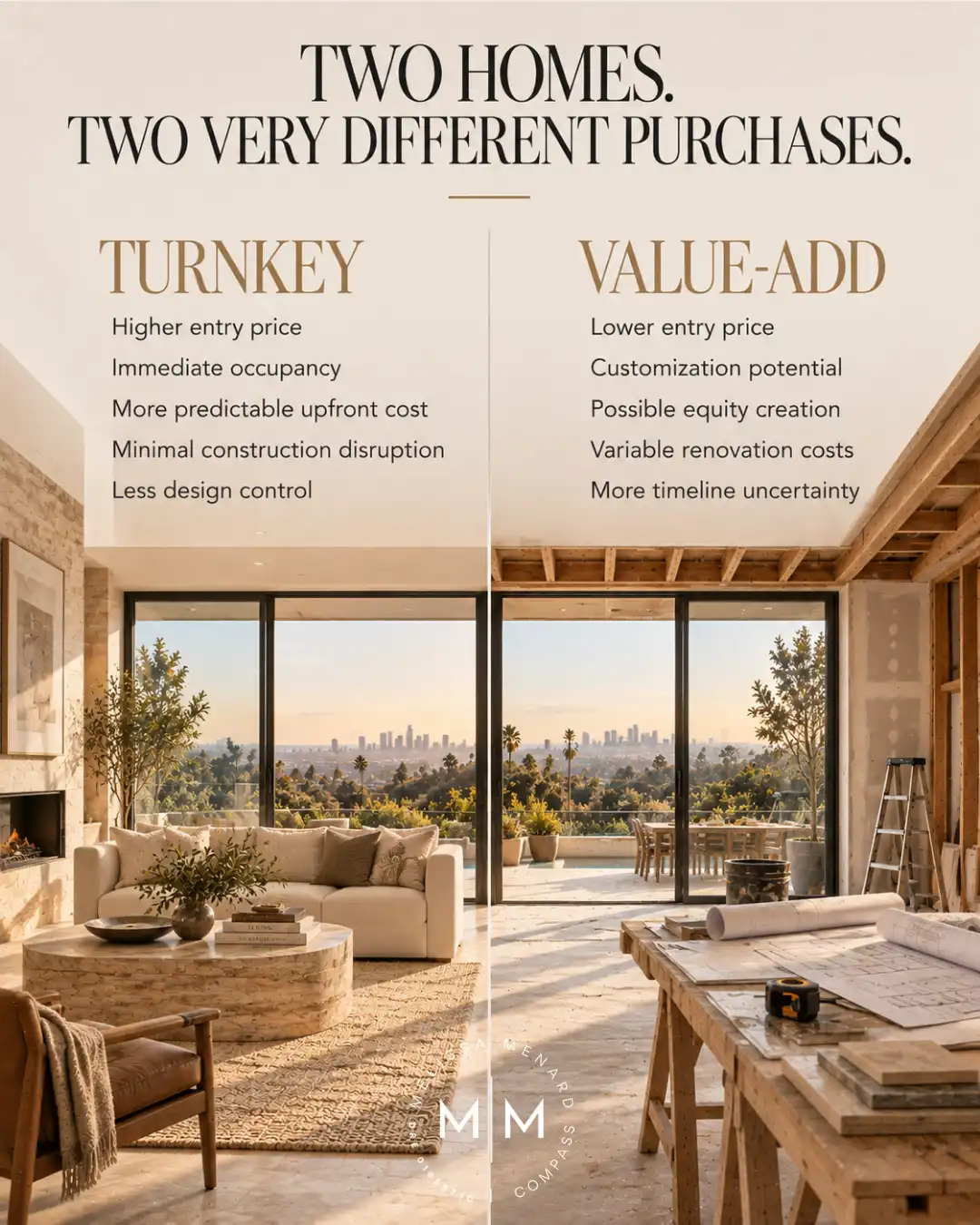
Turnkey Properties (The “Move-In Ready” Strategy)
- Pros: Immediate gratification, predictable fixed costs upfront, locked-in mortgage rate covers the entire value of the home, zero construction stress or displacement.
- Cons: Higher initial purchase price, fierce competition leading to multiple-offer scenarios, potentially compromising on highly specific personal design tastes.
- Best For: Busy professionals, out-of-state relocators, and those who prioritize immediate lifestyle enjoyment over sweat equity.
Value-Add Properties (The “Renovation” Strategy)
- Pros: Lower entry price, ability to customize every finish to your exact specifications, potential to build immediate equity upon completion.
- Cons: Unpredictable timelines and budget overruns, dealing with LA city permits and contractors, out-of-pocket cash required for renovations (not typically financed through a standard mortgage).
- Best For: Experienced investors, buyers with deep local vendor relationships, and those with flexible living arrangements during the construction phase.
Buyer & Seller Considerations for 2026
For Buyers: If you’re leaning toward a turnkey property, your financing needs to be airtight, and your contingencies must be strategically structured. These homes move fast. If you’re drawn to a fixer-upper, I strongly advise bringing a trusted general contractor to your secondary showings. Don’t rely on ballpark estimates; you need hard numbers before removing your inspection contingencies.
For Sellers: If you own a property that sits somewhere in the middle—not quite a tear-down, but not fully updated—we need to talk about strategic, high-ROI improvements. You don’t necessarily need to gut the kitchen. Sometimes, refinishing floors, updating lighting fixtures to warmer, organic tones, and professional staging can bridge the gap and attract buyers who would otherwise pass on a “project.”
Frequently Asked Questions (FAQ)
1. Is it still cheaper to buy a fixer-upper in Los Angeles?
Not necessarily. When you factor in the high cost of local labor, premium materials, and holding costs during the permitting process, the “discount” on a fixer-upper often vanishes.
2. How long does a major renovation take in LA right now?
For a down-to-the-studs remodel or significant addition, you should realistically plan for 12 to 24 months, largely depending on the speed of city approvals and architectural reviews.
3. What is the Measure ULA tax, and does it affect me?
Measure ULA is a transfer tax on properties sold in the City of Los Angeles for over specific financial thresholds (starting around $5.15 million in 2026). It primarily impacts sellers and developers, but buyers must understand how it affects developer inventory and pricing.
4. Are turnkey homes a better investment?
While you might not build “sweat equity,” turnkey homes protect your most valuable asset: time. They also tend to hold their value exceptionally well during market fluctuations because there is always a surplus of buyers who refuse to renovate.
5. What are the most requested turnkey features in 2026?
Wellness amenities are leading the charge. Think built-in cold plunges, circadian rhythm lighting systems, air and water purification systems, and seamlessly integrated outdoor living spaces.
6. Can I finance renovation costs into my mortgage?
There are specific renovation loans (like FHA 203k or Fannie Mae HomeStyle), but they often come with higher interest rates and strict lender oversight. Most luxury buyers use cash or portfolio lines of credit for renovations.
7. How much should I budget per square foot for a high-end remodel in LA?
For true luxury finishes in Los Angeles, you should budget anywhere from $350 to $600+ per square foot, not including exterior hardscaping or pool installation.
8. Is it better to buy turnkey in the Valley or a fixer on the Westside?
This is the ultimate LA real estate debate. It comes down to your lifestyle. If a shorter commute is paramount, a Westside project might make sense. If you want immediate comfort and more space, a turnkey home in Sherman Oaks or Studio City is likely the better play.
9. Do ADUs (Accessory Dwelling Units) add value?
Absolutely. Properties with permitted, move-in ready ADUs are commanding massive premiums. They offer flexible space for multi-generational living, home offices, or passive income.
10. Why are permits so delayed in Los Angeles?
A combination of staffing shortages, backlogs, and incredibly strict structural and environmental codes (like Title 24 energy requirements) contribute to a notoriously slow bureaucratic process.
11. Should I waive inspections on a turnkey home?
I won’t ever advise a client to blindly waive inspections. Even brand-new developments can have hidden flaws. We can structure your offer to be competitive without sacrificing your right to verify the home’s condition.
12. What’s the biggest mistake buyers make with fixer-uppers?
Underestimating the budget. Most buyers assume they can do a kitchen for $50k, but once you open up the walls in an older Los Angeles home, you often find unpermitted work or outdated plumbing that must be brought up to code.
13. Are sellers willing to negotiate on homes that need work?
Yes, properties that require heavy lifting tend to sit on the market longer, providing us with leverage to negotiate price, rate buy-downs, or seller credits.
14. What design trends are dating properties in LA?
The hyper-sterile, ultra-modern “white box” look of the late 2010s is fading. Today’s buyers want organic textures, warm woods, natural stone, and layered, sophisticated architecture.
15. How does hillside living affect renovation costs?
Building in the hills (Hollywood Hills, Bel Air, Sherman Oaks south of the boulevard) triggers strict hillside ordinances, requiring expensive geological surveys, retaining walls, and soil engineering. It significantly increases costs.
16. Does staging really matter for a turnkey home?
Immensely. Staging is what creates the emotional connection. It allows a buyer to walk in and immediately visualize their life unfolding in that space.
17. What should out-of-state buyers prioritize?
If you aren’t local to oversee a project, I strongly urge you to look at turnkey properties. Managing a renovation from a different time zone is a recipe for immense frustration.
18. How do I know if a flip was done well or just cosmetically updated?
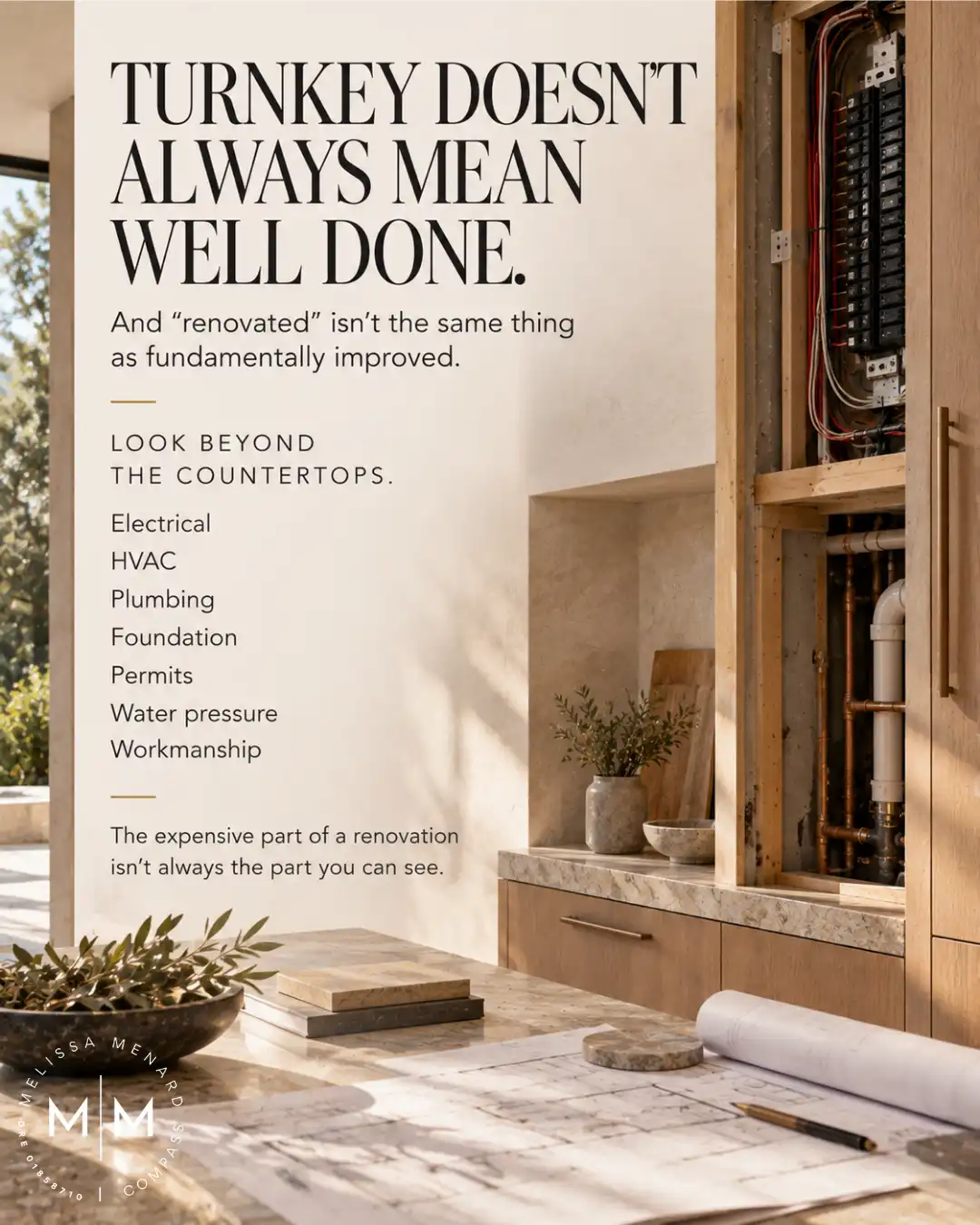
This is where having an experienced advisor is crucial. I look beyond the marble countertops and check the electrical panels, water pressure, foundation bolting, and permit history to ensure the work wasn’t just “lipstick on a pig.”
19. Will interest rates affect my decision between the two?
Yes. When you buy turnkey, you lock in your interest rate on the total finished value of the home. When you renovate with cash, you lose the leverage of a mortgage on those improvement dollars.
20. What is the first step to figuring out which path is right for me?
We sit down for a strategy session. We look at your daily routine, your financial comfort zone, and your long-term goals to determine whether your life is best served by a project or a perfect, finished product.
Closing Perspective
Ultimately, buying real estate in Los Angeles isn’t just a financial transaction; it is a lifestyle declaration. Whether you decide to bypass the dust and move straight into turnkey luxury, or roll up your sleeves to curate a bespoke masterpiece, the most important element is clarity. Don’t make a decision based on an idealized version of a renovation you saw on television. Make it based on your real life, your actual bandwidth, and the specific dynamics of the neighborhood you’re targeting.

Ready to Navigate the Market?
If you’re unsure how your current home fits into this evolving market, or if you’re debating whether to buy a finished home or a value-add property, I’m here to help you gain clarity. Let’s sit down and chart a course that aligns with your lifestyle and financial goals.
Melissa Menard REALTOR® | Compass
Greater Los Angeles & Surrounding Areas
📞 310.729.9726 | DRE# 01858710
📧 melissa@melissamenardhomes.com
🌐 www.MelissaMenardHomes.com
Disclaimer: The information provided in this post is intended for educational purposes only and should not be considered financial, legal, tax, or investment advice. Real estate laws, market conditions, and regulations change over time. Please consult the appropriate licensed professionals regarding your specific situation. All content should comply with applicable Fair Housing laws and regulations.