


Raise your hand if you have a home/condo here in California with a paralyzing fear of giving up a low California property tax base. ✋
For years, I’ve sat in beautifully curated but entirely oversized living rooms in Brentwood, Encino, and the Hollywood Hills, listening to homeowners express a shared frustration. Their homes no longer fit their lifestyles. The kids are gone, the multi-level floor plans feel cumbersome, and the maintenance is endless. Yet, they stay. They stay because the thought of selling their long-held property and trading their notoriously low, grandfathered property tax bill for a modern, reassessed tax rate feels like financial self-sabotage.
On the surface, moving sounds like it means starting over with a brand new, significantly higher tax bill. But there’s a rule most people don’t fully understand, and it is quietly changing everything for homeowners navigating their next chapter in Los Angeles.
Let’s talk about Proposition 19, and why the fear of “losing my low tax bill” doesn’t have to keep you trapped in a home you’ve outgrown or no longer suits your “right now” or “upcoming” lifestyle.

FAST FACTS: Proposition 19 in California
- The Core Benefit: Prop 19 allows eligible California homeowners to transfer their current, lower property tax base to a new primary residence anywhere within the state.
- Who Qualifies: You must be 55 years of age or older, severely disabled, or a victim of a wildfire or natural disaster.
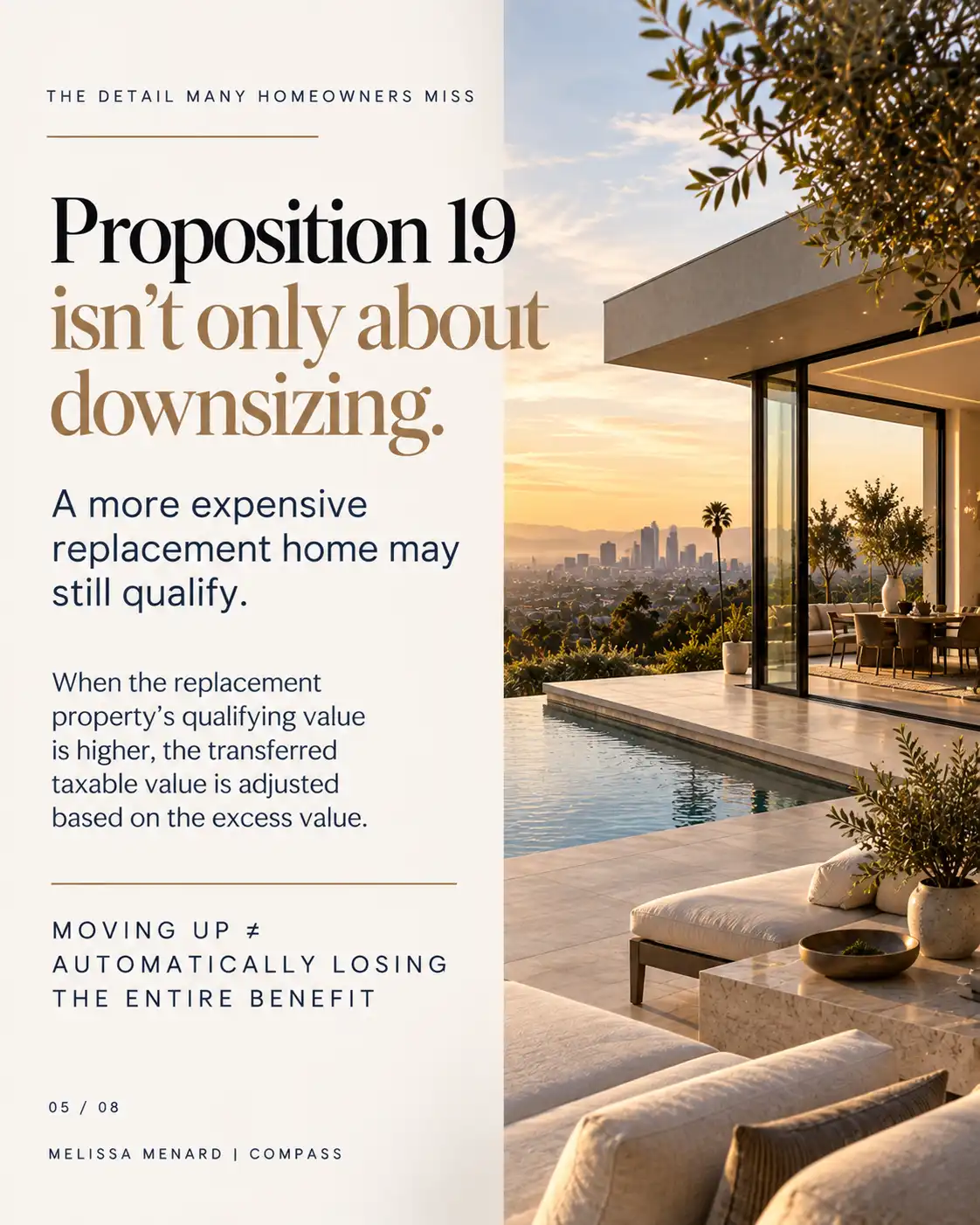
- Price Flexibility: You can move to a home of equal or lesser value and keep your exact tax basis. Remarkably, you can also move to a more expensive home and only pay reassessed taxes on the price difference.
- Lifetime Usage: Unlike previous legislation (which limited this move to a one-time event), eligible homeowners can now utilize this tax base transfer up to three times in their lifetime.
- Location Independence: The transfer applies anywhere within the state of California, meaning you aren’t restricted to staying within Los Angeles County.
The Psychological Weight of the Wrong House
It’s an incredibly common Los Angeles story. You bought your home in Sherman Oaks or Beverly Hills decades ago. You’ve built tremendous equity, but your lifestyle has fundamentally shifted. Perhaps you crave a turnkey, single-story architectural gem in Studio City so you can lock and leave for travel without worrying about a sprawling estate.

The barrier hasn’t been a lack of equity; it’s been the math. Trading a $2,500 annual tax bill for a $25,000 one is a tough pill to swallow, even for high-net-worth individuals. I call these the “golden handcuffs” of California real estate. Prop 19 acts as the key to unlock them. By allowing you to carry your favorable tax basis with you, the legislation shifts the conversation from “Can we afford the new taxes?” to “Where do we actually want to live right now?”
Navigating the Financial Mechanics: Moving Up vs. Scaling Down
What makes Prop 19 so revolutionary for my Los Angeles clients is its flexibility. Prior to this law, if you bought a replacement property that was even one dollar over the value of your original home, you lost the tax transfer benefit entirely.
Today, the rules reflect reality.
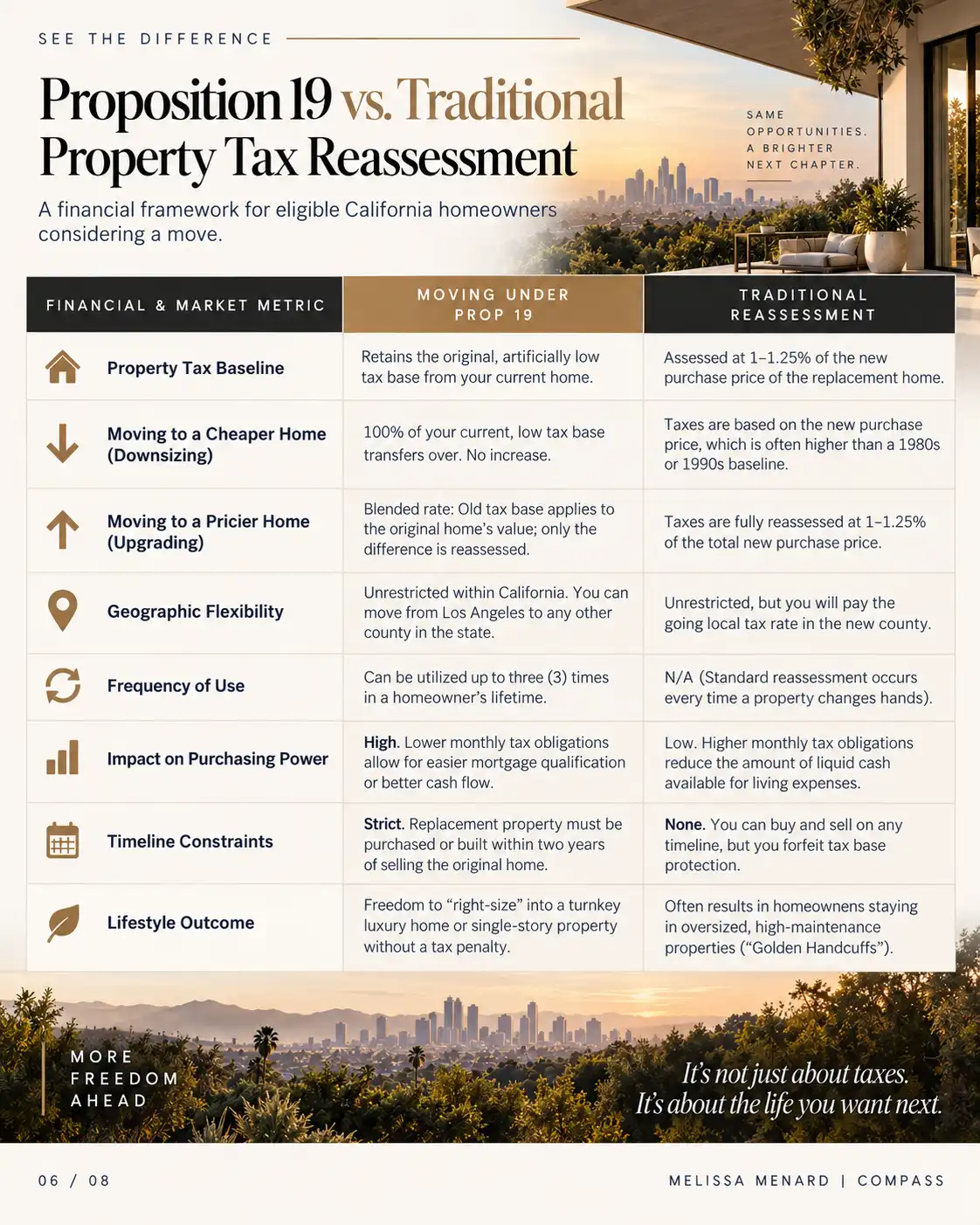
- The Lateral or Downsize Move: If you sell your current home for $3 million and buy a beautiful, low-maintenance $2.5 million property, your current property tax base transfers entirely. Nothing changes.
- The Upgrade Move: Let’s say you want to move closer to the water or into a more exclusive, turnkey luxury building. You sell your home for $3 million, but your dream replacement property is $4 million. Under Prop 19, your original tax base transfers over, and you only pay the new tax rate on the $1 million difference.
It completely changes the math, allowing you to prioritize your lifestyle, comfort, and architectural preferences over municipal tax fears.
Comparative Breakdown: Staying Put vs. Leveraging Prop 19

When evaluating whether to hold onto your current property or make a move, it’s essential to look at the holistic picture. Here is how the two paths generally compare for Los Angeles homeowners over 55:
Staying in Your Current (Outgrown) Home
- Tax Implications: Property taxes remain low, capped by Prop 13 (max 2% annual increase).
- Lifestyle Impact: High. You remain tied to a floor plan, maintenance schedule, and neighborhood that may no longer serve your daily routine.
- Financial Drain: Older, larger homes require significant ongoing capital for deferred maintenance, landscaping, and utility costs, which often outpace the “savings” of the low tax bill.
- Best For: Homeowners who genuinely still utilize every square foot of their property and possess deep, ongoing community ties to their immediate street.
Relocating Using Prop 19
- Tax Implications: You retain your low, original tax base on the replacement home. If you upgrade in price, a blended rate applies only to the overage.
- Lifestyle Impact: Transformative. You can right-size your living space, opt for turnkey modern amenities, eliminate stairs, or move closer to family.
- Financial Efficiency: Equity is freed up or reallocated into an asset that requires less day-to-day capital to maintain, improving cash flow and peace of mind.
- Best For: Empty nesters, retirees, or anyone feeling burdened by their current property who wants a home tailored to their next twenty years.
Buyer & Seller Considerations in 2026
For Sellers (Preparing Your Departure): If you’re relying on Prop 19, the timing of your transactions is paramount. You have a two-year window to complete the purchase of your replacement property (either before or after the sale of your original home). However, to maximize your return on the home you’re leaving, we need to prepare it for today’s buyer. We don’t necessarily need to do a gut remodel, but strategic cosmetic updates—fresh paint, staging, and minor landscaping—ensure we capture top dollar to fund your next chapter.
For Buyers (Targeting Your Destination): Finding a turnkey, move-in-ready home in Los Angeles is highly competitive right now. Because you aren’t constrained by county lines under Prop 19, we have the flexibility to cast a wider net. Whether that means a luxury condo in West Hollywood or a serene mid-century modern in the Hollywood Hills, we can structure your offers confidently, knowing your tax liability is protected.

Frequently Asked Questions (FAQ)
1. What exactly is Proposition 19?
Prop 19 is a California constitutional amendment that allows eligible homeowners to transfer the taxable value of their primary residence to a replacement primary residence anywhere in the state.
2. Who is eligible for the Prop 19 tax base transfer?
You must be 55 years of age or older, severely disabled, or a victim of a wildfire or other natural disaster declared by the Governor.
3. Do I have to buy a home in Los Angeles County?
No. One of the greatest benefits of Prop 19 is that it allows intercounty transfers. You can sell in LA and buy in Santa Barbara, Orange County, Palm Springs, or anywhere else in California.
4. Can I buy a more expensive home and still use Prop 19?
Yes. You will keep your original tax base for the value up to the sale price of your old home, and a reassessed value will be added only for the amount the new home’s price exceeds the old home’s sale price.
5. How many times can I use this tax transfer?
If you qualify by age (55+) or severe disability, you can transfer your tax base up to three times in your lifetime. Disaster victims can use it once per disaster.
6. Does the replacement property have to be my primary residence?
Yes. Both the original property being sold and the replacement property being purchased must serve as your primary residence to qualify.
7. How long do I have to buy a new home after selling my old one?
You have exactly two years from the sale of your original property to purchase or construct your replacement property.
8. Can I buy my new home before I sell my current one?
Yes. The two-year window applies in either direction. You can purchase your replacement home first, as long as you sell your original home within two years of that purchase date.
9. Does Prop 19 apply to investment properties or second homes?
No. The tax base transfer portion of Prop 19 strictly applies to primary residences.
10. What happens if I buy a less expensive home?
If the market value of your new home is equal to or less than the sale price of your original home, your exact current property tax base transfers over entirely.
11. How do I actually apply for the Prop 19 benefit?
You must file a claim form with the County Assessor’s office in the county where your new replacement property is located.
12. If my spouse is 55 but I am not, do we still qualify?
Yes. As long as one homeowner on the title meets the age requirement of 55 or older, you can utilize the Prop 19 transfer.
13. Does this rule apply if I want to build a new home instead of buying an existing one?
Yes. You can purchase land and construct a new primary residence, provided the construction is completed and you move in within the two-year window.
14. What if I own my home in a trust?
Homes held in a revocable living trust generally qualify, as the trustors are considered the beneficial owners. However, it is critical to consult with your estate attorney to ensure the trust is structured correctly for the transfer.
15. Can I combine my tax base with my partner’s if we both sell our homes?
No. You cannot combine two separate tax bases into a single replacement property. You would have to choose the most advantageous tax base to transfer.
16. Are there any hidden fees associated with the transfer?
There are no “hidden fees” for the transfer itself, but standard closing costs, transfer taxes (like LA’s Measure ULA, if applicable to the sale price), and recording fees still apply to the real estate transactions.
17. Will my mortgage lender care about my Prop 19 status?
Your lender will care because lower property taxes positively impact your debt-to-income (DTI) ratio, potentially making it easier to qualify for a mortgage on the replacement property.
18. Do I lose my Prop 13 protection if I use Prop 19?
No. Once your tax base is transferred to the new property via Prop 19, that new base continues to be protected by Prop 13, meaning it can only increase by a maximum of 2% per year.
19. How long does the county take to process the Prop 19 application?
Processing times vary by county, but it can take several months. You may have to pay the higher, reassessed tax rate initially, and the county will issue a refund once the Prop 19 claim is approved.
20. Do I really need an agent who understands this law?
Absolutely. The timing, the disclosures, and the strategic coordination of selling and buying within the required window are complex. You need an advisor who understands how to protect your timeline and your wealth.
Closing Perspective
Real estate in Los Angeles is about much more than brick and mortar; it’s about aligning your environment with the current season of your life. For years, arbitrary tax penalties kept people living in the past, managing properties that no longer served them. Prop 19 changes the math entirely. It gives you the freedom to downsize, right-size, or relocate without the penalty of a skyrocketing tax bill.
If you are sitting in a home that you’ve outgrown simply because you’re afraid of losing your property tax rate, it’s time we look at the actual numbers. You might be surprised to find that your next chapter is far more accessible than you think.
Ready to Explore Your Options?
If you’re 55 or older and curious about how Proposition 19 could specifically impact your property tax bill if you were to move, I’m here to help. Let’s sit down, run the scenarios, and chart a course that protects your wealth while upgrading your lifestyle.

Melissa Menard REALTOR® | Compass
Greater Los Angeles & Surrounding Areas
📞 310.729.9726 | DRE# 01858710
📧 melissa@melissamenardhomes.com
🌐 www.MelissaMenardHomes.com
Disclaimer: The information provided in this post is intended for educational purposes only and should not be considered financial, legal, tax, or investment advice. Real estate laws, market conditions, and regulations change over time. Please consult the appropriate licensed professionals regarding your specific situation. All content should comply with applicable Fair Housing laws and regulations.