


You can have excellent credit, strong income, an appropriate down payment and a loan preapproval—and still encounter a financing issue when purchasing a condominium.
Why?
Because with a condo, the lender isn’t evaluating only the borrower.
The condominium project itself can also have to qualify.
That distinction has become increasingly important as Fannie Mae and Freddie Mac update the standards lenders use to evaluate condominium projects.
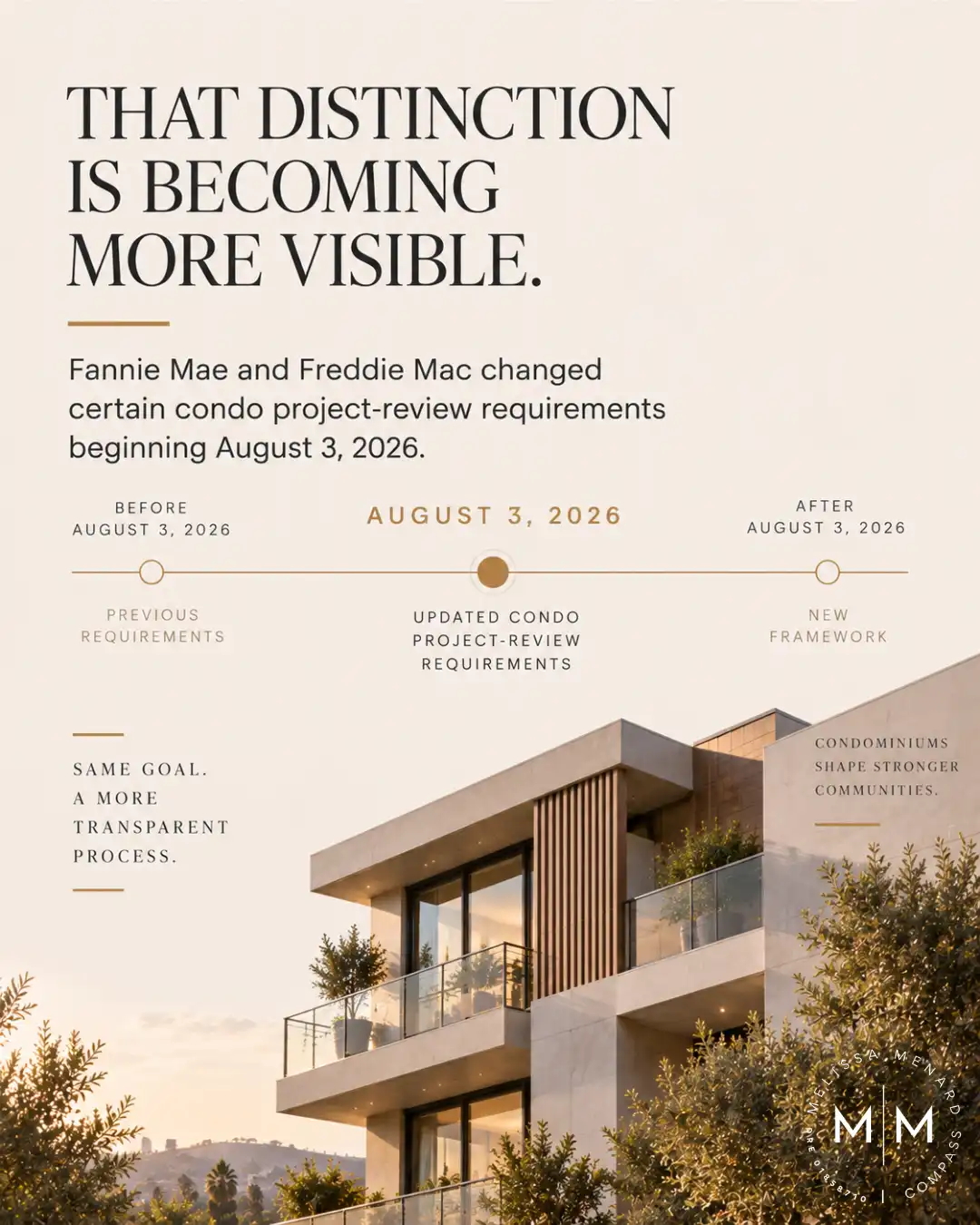
One significant change became effective August 3, 2026: Fannie Mae retired its Limited Review process and Freddie Mac retired its Streamlined Review option for applicable new loan applications.
Another change arrives January 4, 2027, when both agencies increase the standard minimum replacement-reserve allocation from 10% to 15% of annual budgeted assessment income for applicable project reviews.
For Los Angeles condo buyers, sellers and homeowners, these may sound like technical lending changes.
Their practical importance is much easier to understand:
- The financial and physical health of the HOA can become part of the financing conversation.
And that makes investigating the building earlier—not merely the individual unit—an increasingly important part of evaluating a condominium purchase.
FAST FACTS
What changed August 3, 2026?
Fannie Mae retired its Limited Review process for loan applications dated on or after August 3, 2026. Freddie Mac similarly limits use of its Streamlined Review to condominium unit mortgage applications received before August 3, 2026.
Does every condominium now require a Full Review?
No. Full Review/Established Project Review will apply in situations that previously may have qualified for the retired review options, but Fannie Mae’s Waiver of Project Review and Freddie Mac’s Exempt From Review provisions can still apply to certain eligible projects and transactions.
What’s changing January 4, 2027?
For applicable reviews, the minimum replacement-reserve allocation increases from 10% to 15% of annual budgeted assessment income.
Can a reserve study matter?
Yes. When a qualifying reserve study is used instead of the standard reserve-allocation calculation, updated agency requirements address how its recommendations must be evaluated.
What else can lenders examine?
Depending on the applicable project-review requirements, issues involving budgets, reserves, special assessments, critical repairs or significant deferred maintenance, insurance and other project characteristics can affect eligibility.
Why should buyers care?
A condo purchase involves both the residence and a shared ownership structure. A borrower may qualify financially while the project presents a separate financing issue.
The Part of Condo Financing Buyers Don’t Always See
Most buyers understandably begin the financing conversation with their own numbers:
- Income.
- Credit.
- Assets.
- Debt.
- Down payment.
- Interest rate.
- Monthly payment.
- Those numbers still matter.

But a condominium introduces another layer because the individual residence exists inside a larger legal and financial structure.
The association may be responsible for roofs, exterior walls, elevators, garages, common plumbing, landscaping, recreational facilities, structural components and other shared elements depending on the particular community.
Owners fund those obligations collectively through assessments.
That means the condition and finances of the association can matter to the long-term viability of the property securing the mortgage.
This is why condo underwriting can feel different from financing a single-family residence.
There are effectively two questions:
- Can the borrower qualify for the mortgage?
- And does the condominium project meet the applicable lender and investor requirements?
A “yes” to the first question doesn’t automatically answer the second.
What Changed on August 3, 2026?
Fannie Mae announced in March 2026 that it was retiring its Limited Review process.
For loan applications dated on or after August 3, established projects that previously qualified for Limited Review must instead use the applicable Full Review process or, when eligible, Fannie Mae’s Waiver of Project Review.

Freddie Mac made a corresponding change to its Streamlined Review process. Streamlined Review may only be used when the application-received date for the condominium unit mortgage is before August 3, 2026.
The distinction about waivers is important.
You may hear this change summarized as:
- “Every condo now needs a Full Review.”
That’s easier to remember—but it isn’t quite accurate.
There remain circumstances in which an eligible transaction or project can qualify for a Fannie Mae Waiver of Project Review or Freddie Mac Exempt From Review treatment.
For consumers, there’s no need to memorize every agency review category.
The more useful takeaway is this:
- Don’t assume that because a condominium financed easily in the past, the next transaction involving that building will automatically be reviewed the same way.
The loan program, transaction, project characteristics and current guidelines all matter.
The Next Change: Reserves Increase to 15%
A second major change becomes mandatory for applicable loan applications dated or received on or after January 4, 2027.
Fannie Mae and Freddie Mac are increasing the standard minimum replacement-reserve allocation from 10% to 15% of annual budgeted assessment income.
These aren’t simply dollars sitting in the HOA’s operating account to pay this month’s landscaping or utility bill.
Replacement reserves are intended for longer-term capital expenditures and deferred maintenance.

Think about the larger components of a condominium property:
- A roof eventually needs replacement.
- An elevator requires significant work.
- Exterior waterproofing may be necessary.
- A parking structure may require repairs.
- Mechanical equipment ages.
- Exterior paint and building systems have useful lives.
A financially prepared association anticipates those costs rather than treating every major repair as an unexpected event.
Why did the agencies increase the requirement?
Fannie Mae explained when announcing the change that it had observed a relationship between underfunded reserves and condominium projects requiring critical repairs.
The concern is straightforward.
When a major building component requires work, the money has to come from somewhere.
If adequate reserves aren’t available, an association may need to increase regular assessments, impose a special assessment, borrow money, postpone work or use some combination of those approaches.
The reserve requirement is therefore less about an arbitrary percentage than about the long-term financial capacity of the project.
What About the Reserve Study?
This is another area where the headline can oversimplify the actual rule.
The agencies don’t simply say:
- “Every HOA must put exactly 15% into reserves.”
Their guidelines provide mechanisms involving qualifying reserve studies.
For example, Fannie Mae’s updated policy allows an acceptable reserve study to be used in circumstances specified by its guidelines, but when that flexibility is used, the project budget must include the highest recommended reserve allocation contained in the study.
The agencies also eliminated use of the baseline funding methodology for this purpose for applicable applications beginning August 3, 2026.
For a buyer, the technical calculation belongs with the lender and underwriting team.
But the existence and conclusions of a reserve study can still tell you something valuable about the building you’re considering.
It may identify anticipated component replacements, expected useful lives, estimated costs and recommended funding.
That’s useful information even beyond the mortgage.
What Could a Lender Look At?
The exact documentation and requirements depend on the loan, project and applicable agency guidelines, but several categories deserve attention during a condo transaction.
1. The HOA Budget
The budget helps reveal how the association expects to fund its ongoing responsibilities.
A lender’s project review may consider whether the budget is adequate for the type of project and whether required replacement reserves are being funded.
From a buyer’s perspective, the budget also helps answer a broader question:
Does the HOA’s financial plan appear consistent with the property it has to maintain?
A small condominium with limited common elements and a high-rise with elevators, extensive mechanical systems and structured parking have very different maintenance obligations.
The dollar amount alone doesn’t tell the entire story.
2. Replacement Reserves
Reserve balances and reserve contributions aren’t the same thing.
The association may have money accumulated in its reserve account while also budgeting annual contributions toward future capital needs.
The applicable agency guidelines establish standards for evaluating reserve funding.
For buyers, this is where reviewing the budget alongside the reserve study can provide considerably more context than looking at the monthly HOA assessment alone.
3. Special Assessments
A special assessment isn’t automatically evidence that an HOA is poorly managed.
Sometimes a substantial capital project is necessary and an assessment is the association’s chosen method of funding it.
But the details matter.
- What is the assessment paying for?
- How much is it?
- How long will owners pay it?
- Has the work begun?
- Is additional work anticipated?
- Are owners delinquent?
- Could the assessment or underlying condition affect financing?
Those are much more useful questions than simply asking whether a special assessment exists.
4. Repairs and Deferred Maintenance
Physical condition has become an increasingly significant component of condominium project eligibility.
Lenders may need information concerning critical repairs, significant deferred maintenance and certain inspections.
For buyers, that means the physical condition of the building deserves attention alongside the inspection of the unit.
A beautifully renovated kitchen doesn’t tell you the condition of the roof, garage, balconies, exterior envelope or shared building systems.
5. Association Insurance
Insurance has become one of the most consequential—and sometimes complicated—parts of condominium financing.
Fannie Mae’s Condo Status Finder currently identifies insufficient master property insurance and critical repair issues among the leading reasons projects receive an ineligible status in its system.
In California, where insurance conditions have received substantial attention, this deserves early consideration.
The relevant question isn’t simply:
- “Does the HOA have insurance?”
The applicable coverage must satisfy the requirements of the lender and loan program.
6. The Reserve Study
A reserve study can provide a longer-term picture of anticipated capital needs.
For buyers, it can help put the current budget and reserve balance into context.
A large reserve account may initially look reassuring.
But if the building anticipates several expensive projects over the next few years, the number takes on a different meaning.
Conversely, an upcoming project doesn’t necessarily mean the association is financially unprepared if that expense has been anticipated and appropriately funded.
Context matters.
7. Project Characteristics and Size
Project size and structure can influence which review requirements apply.
Both agencies have specific provisions for smaller condominium projects, including certain projects with ten or fewer units.
That’s another reason broad statements such as “every condo now requires a Full Review” can be misleading.
A lender needs to determine the appropriate review method for the specific transaction.
Why This Matters in Los Angeles
Los Angeles doesn’t have one uniform type of condominium.
A buyer might be considering a four-unit building in West Los Angeles, a mid-century condominium in West Hollywood, a high-rise residence in Century City, a coastal building in Santa Monica or Marina del Rey, or a larger amenity-driven development elsewhere in the region.
Those properties can have dramatically different financial and physical obligations.
An elevator changes the maintenance picture.
So does subterranean parking.
A pool changes it.
So does an aging roof.
Balconies, exterior waterproofing, central mechanical systems, common plumbing and extensive landscaping can all create different long-term capital requirements.
That makes the HOA assessment itself a poor shortcut for determining whether a condominium is financially healthy.
A lower HOA payment isn’t automatically better.
And a higher HOA payment isn’t automatically evidence of poor management.
The better question is:
- What does the assessment fund, and is that funding appropriate for the building?
That’s a much more useful way to evaluate condominium ownership.
What Condo Buyers Can Do Earlier
The goal isn’t to turn buyers into condominium underwriters.
It’s to identify questions early enough that the professionals involved in the transaction have time to get answers.
Before becoming deeply committed to a condominium, consider discussing these questions with your lender and real estate advisor:
- What project-review method is likely to apply?
Ask your lender whether they can identify potential project eligibility concerns early.
What documentation is available?
Depending on the transaction, useful documents may include the current budget, financial statements, reserve information, reserve study, insurance information, HOA meeting minutes, assessment information and governing documents.
- Are there current or planned special assessments?
Understand both the financial obligation and the reason behind it. - Are significant repairs underway or anticipated?
Find out what is being repaired, why, how it is being funded and whether additional phases are expected. - Has the association completed a recent reserve study?
If so, compare its recommendations with the association’s actual funding plan. - Is there anything about the project that could affect conventional financing?
Your lender—not the listing agent or HOA—should ultimately determine whether the project satisfies the requirements for the particular loan.
What Condo Sellers and Owners Should Understand
These changes aren’t relevant only when you’re buying.
They can matter when you’re selling, too.
Imagine two nearly identical units in competing buildings.
Both sellers are qualified to sell.
Both buyers are financially strong.
Both properties appraise appropriately.
But one association can promptly provide complete financial, insurance and project documentation that satisfies underwriting requirements, while the other discovers an unresolved eligibility issue halfway through escrow.
Those can become very different transactions.
For condo owners contemplating a future sale, understanding the financial and physical condition of the association before listing can be useful preparation.
That doesn’t mean an individual owner can control the HOA.
But an owner can become informed.
Review association communications.
Attend meetings.
Understand upcoming capital projects.
Know whether a reserve study exists.
Pay attention to insurance discussions.
Understand current assessments.
And if you’re preparing to sell, consider discussing project documentation with your real estate advisor before accepting an offer involving financing.
The question isn’t simply whether your individual residence is ready for market.
Is the building ready for the financing scrutiny that may accompany the next buyer?
The Larger Lesson: You’re Buying More Than the Unit

Condominium buyers tend to focus on what they can see.
- The floor plan.
- The kitchen.
- Natural light.
- Views.
- Outdoor space.
- Parking.
- Storage.
Those characteristics absolutely matter.
But condo ownership has another layer.
You’re also buying into an association that collectively maintains and finances a larger physical asset.
That makes the budget, reserve strategy, insurance coverage and maintenance history part of the ownership story.
The new financing requirements don’t create that reality.
They simply make it harder to ignore.
Frequently Asked Questions
1. What changed for condo financing on August 3, 2026?
Fannie Mae retired its Limited Review process for applicable loan applications dated on or after August 3, 2026. Freddie Mac similarly retired Streamlined Review for applications received on or after that date.
2. Do all condos now require a Full Review?
No. Some eligible projects and transactions may still qualify for Fannie Mae’s Waiver of Project Review or Freddie Mac’s Exempt From Review provisions.
3. What is a condo project review?
It is the lender’s evaluation of the condominium project against applicable loan and investor eligibility requirements, separate from underwriting the individual borrower.
4. Can I qualify for a mortgage but have the condo project fail to qualify?
Yes. Borrower qualification and project eligibility are separate considerations in condominium financing.
5. When does the new 15% reserve requirement begin?
For applicable reviews, the requirement becomes mandatory for Fannie Mae loan applications dated and Freddie Mac applications received on or after January 4, 2027.
6. Is the reserve requirement currently 10%?
For applicable project reviews before the January 4, 2027 effective date, the standard minimum reserve-allocation requirement remains 10% under the relevant agency requirements.
7. Does the HOA have to keep 15% of its money in a reserve account?
That’s not how the standard is calculated. The requirement concerns the annual budgeted replacement-reserve allocation relative to annual budgeted assessment income.
8. Does every condominium need a reserve study for Fannie Mae financing?
No. Fannie Mae specifically states that it does not universally require lenders to evaluate project-level reserve studies to determine eligibility. Reserve studies can, however, be relevant under certain project-review provisions.
9. What is a reserve study?
A reserve study evaluates major common components, their anticipated remaining useful lives, estimated replacement or repair costs and an appropriate funding strategy.
10. Can a special assessment prevent condo financing?
It can affect project review depending on the circumstances, but the existence of an assessment alone doesn’t answer the eligibility question. The lender must evaluate it under the applicable guidelines.
11. Are special assessments always bad?
No. The purpose, amount, funding structure, owner delinquencies and underlying work all matter.
12. Can deferred maintenance affect financing?
Yes. Critical repairs and significant deferred maintenance can affect condominium project eligibility.
13. Does HOA insurance affect a buyer’s mortgage?
Yes. Applicable project insurance requirements must be satisfied.
14. Why does the lender care about the HOA’s finances?
Because owners share financial responsibility for common property, and inadequate project resources can affect maintenance, assessments and the collateral securing the mortgage.
15. Should I review HOA documents before buying a condo?
Yes. The applicable documents and review period depend on the transaction, but association financial and governance information can provide important information about ownership.
16. Should I ask about condo eligibility before making an offer?
When financing is involved, discussing potential project eligibility with your lender early can help identify issues that may otherwise arise later.
17. Does a low HOA fee mean the building is financially healthy?
Not necessarily. The more meaningful question is whether revenue, expenses and reserve funding are appropriate for the project’s obligations.
18. Does a high HOA fee mean a building is financially unhealthy?
No. Assessments can reflect amenities, staffing, utilities, insurance, reserve contributions and other expenses. The underlying budget matters more than the number in isolation.
19. Can an HOA’s reserve balance be large but still be inadequate?
Potentially. Reserve adequacy depends partly on the project’s anticipated capital obligations, not merely the current account balance.
20. Are small condo buildings treated differently?
They can be. Fannie Mae and Freddie Mac have specific provisions affecting certain smaller projects, including some projects containing ten or fewer units.
21. Can a condo’s financing eligibility change over time?
Yes. Project conditions, insurance, repairs, finances, assessments and agency guidelines can change.
22. Does previous financing in the building guarantee my loan will be approved?
No. A prior transaction doesn’t establish eligibility for a future loan under different circumstances or guidelines.
23. Who determines whether the condominium project qualifies?
The lender is responsible for determining project eligibility under the requirements applicable to the mortgage being originated.
24. What should a Los Angeles condo seller do before listing?
Consider gathering current HOA documentation and understanding significant assessments, repairs, reserve issues and insurance matters so potential financing questions can be addressed earlier.
25. What’s the most important takeaway for condo buyers?
Evaluate the building as carefully as you evaluate the residence. Financing can depend on both.
Closing Perspective
The financing changes taking effect in 2026 and 2027 aren’t a reason to avoid condominiums.
They are a reason to evaluate them more completely.
A condominium is simultaneously a private residence and an interest in a shared property.
The finishes inside the unit may influence whether you love the home.
The financial and physical condition of the building can influence what owning—and financing—it looks like.
So perhaps the better question when considering your next condo isn’t simply:
“Do I qualify to buy this?”
It’s also:
“What do I need to understand about the building before I buy into it?”
If you’re considering a condominium purchase or preparing to sell one in Greater Los Angeles, Schedule a Strategy Consultation to discuss what should be investigated early and which questions belong with your lender, HOA, insurance professional or other advisors.

Melissa Menard REALTOR® | Compass
The Greater Los Angeles Area
📞 310.729.9726 | DRE# 01858710
📧 melissa@melissamenardhomes.com
🌐 www.MelissaMenardHomes.com
Disclaimer: The information provided in this post is intended for educational purposes only and should not be considered financial, legal, tax, or investment advice. Real estate laws, market conditions, and regulations change over time. Please consult the appropriate licensed professionals regarding your specific situation. All content should comply with applicable Fair Housing laws and regulations.