


I often notice that in shifting real estate markets, buyers and sellers tend to stare at each other from opposite sides of a widening gap. The seller is looking at their property’s value based on neighborhood comparisons, while the buyer is looking at their monthly payment based on current interest rates. When those two realities don’t align, negotiations can easily stall.
But I’m here to tell you that the most successful transactions in Los Angeles right now aren’t always about dramatically slashing the purchase price. Instead, they rely on a more nuanced, strategic tool: the interest rate buydown.
Whether you’re trying to make your monthly payment more digestible or you’re a seller trying to protect your home’s equity while still attracting strong offers, understanding how to creatively structure a buydown can be the exact bridge needed to bring a deal together. According to recent mortgage industry data from Freddie Mac, navigating the current interest rate environment requires flexibility, and seller concessions have become one of the most powerful levers in modern real estate negotiations.
Here is a deep dive into how buyers and sellers in the Los Angeles area can strategically leverage rate buydowns to create win-win scenarios.
FAST FACTS: What You Need to Know About Rate Buydowns
- Definition: A mortgage rate buydown is a financing technique where an upfront fee is paid (usually by the seller or builder) to lower the buyer’s interest rate for a set period or the life of the loan.
- Temporary vs. Permanent: Temporary buydowns (like the 2-1 or 3-2-1) lower the rate for the first few years of the loan. Permanent buydowns (discount points) lower the rate for the entire loan term.
- The Escrow Account: In a temporary buydown, the upfront cash concession from the seller is held in a secure escrow account by the lender and used to supplement the buyer’s monthly payment.
- Refinancing Perks: If a buyer refinances before a temporary buydown period ends, the remaining unused funds in the escrow account are typically applied to the principal balance of the loan.
- Strategic Advantage: For sellers, funding a rate buydown often costs significantly less than a traditional price reduction while delivering more monthly savings to the buyer.
The Los Angeles Context: Why Price Drops Aren’t Always the Answer

In a high-value market like Los Angeles—from the Hollywood Hills to the South Bay—a shift in interest rates dramatically impacts purchasing power. When affordability gets squeezed, the immediate reflex for many buyers is to demand a price reduction.
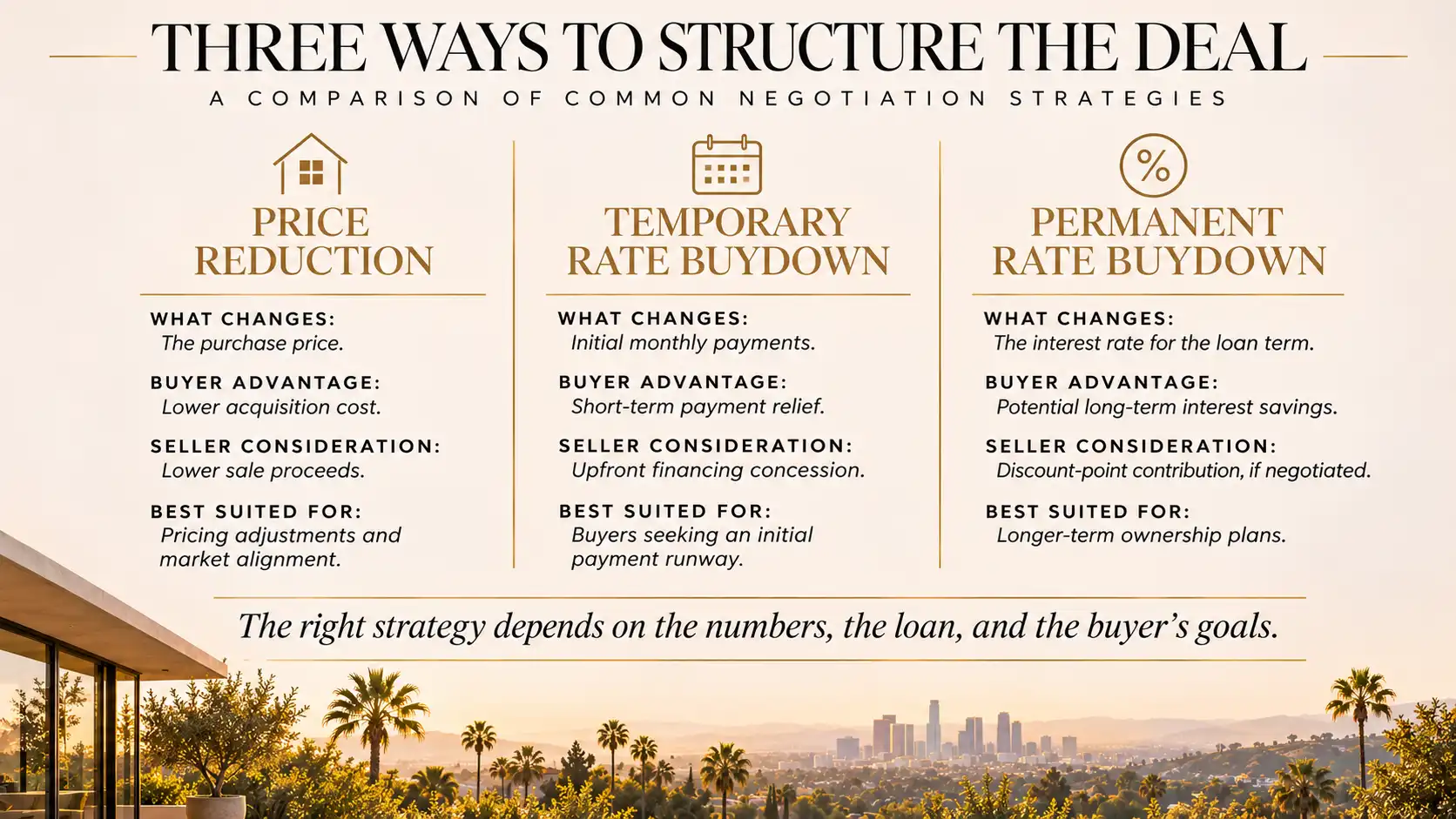
However, a price reduction doesn’t always move the needle on a monthly payment as much as you’d think. Let’s say a seller drops the price of a $1.5 million home by $50,000. For the buyer, that might only reduce their monthly payment by a couple of hundred dollars. But if that same seller took just $30,000 of that money and applied it toward a 2-1 interest rate buydown for the buyer, the buyer’s monthly payment could drop by over $1,000 a month for the first year.
It’s a powerful shift in perspective. Sellers preserve their neighborhood comparables, and buyers get the meaningful, immediate payment relief they actually need to comfortably transition into their new home.
Understanding the Mechanics: Types of Buydowns
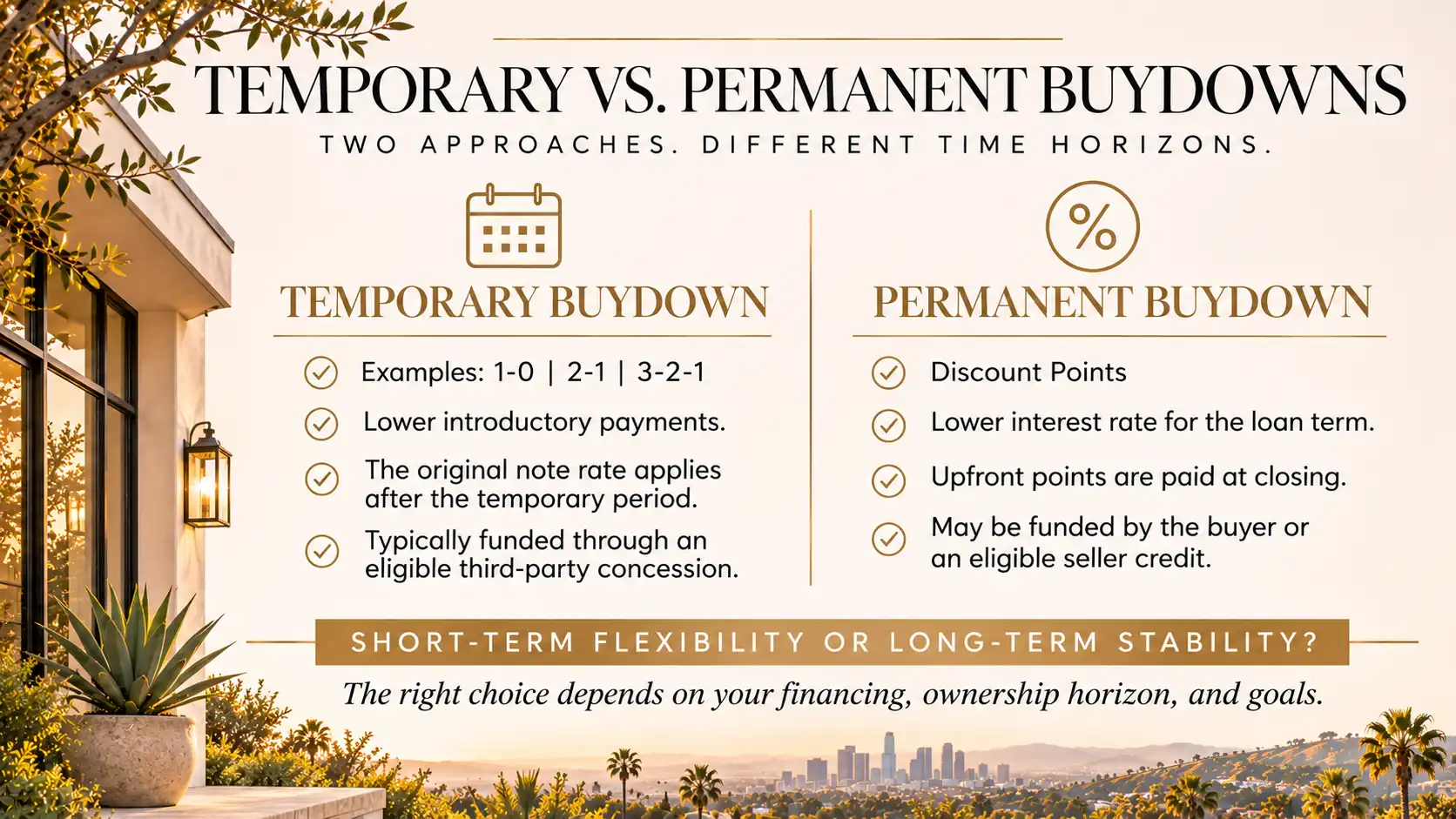
If you’re considering this strategy, it’s important to understand the different vehicles available. We typically see two main categories in today’s market.
1. The Temporary Buydown (The “Runway” Strategy)
Temporary buydowns are designed to ease a buyer into their full mortgage payment over a few years. They are almost exclusively funded by the seller (as a concession) or a builder.
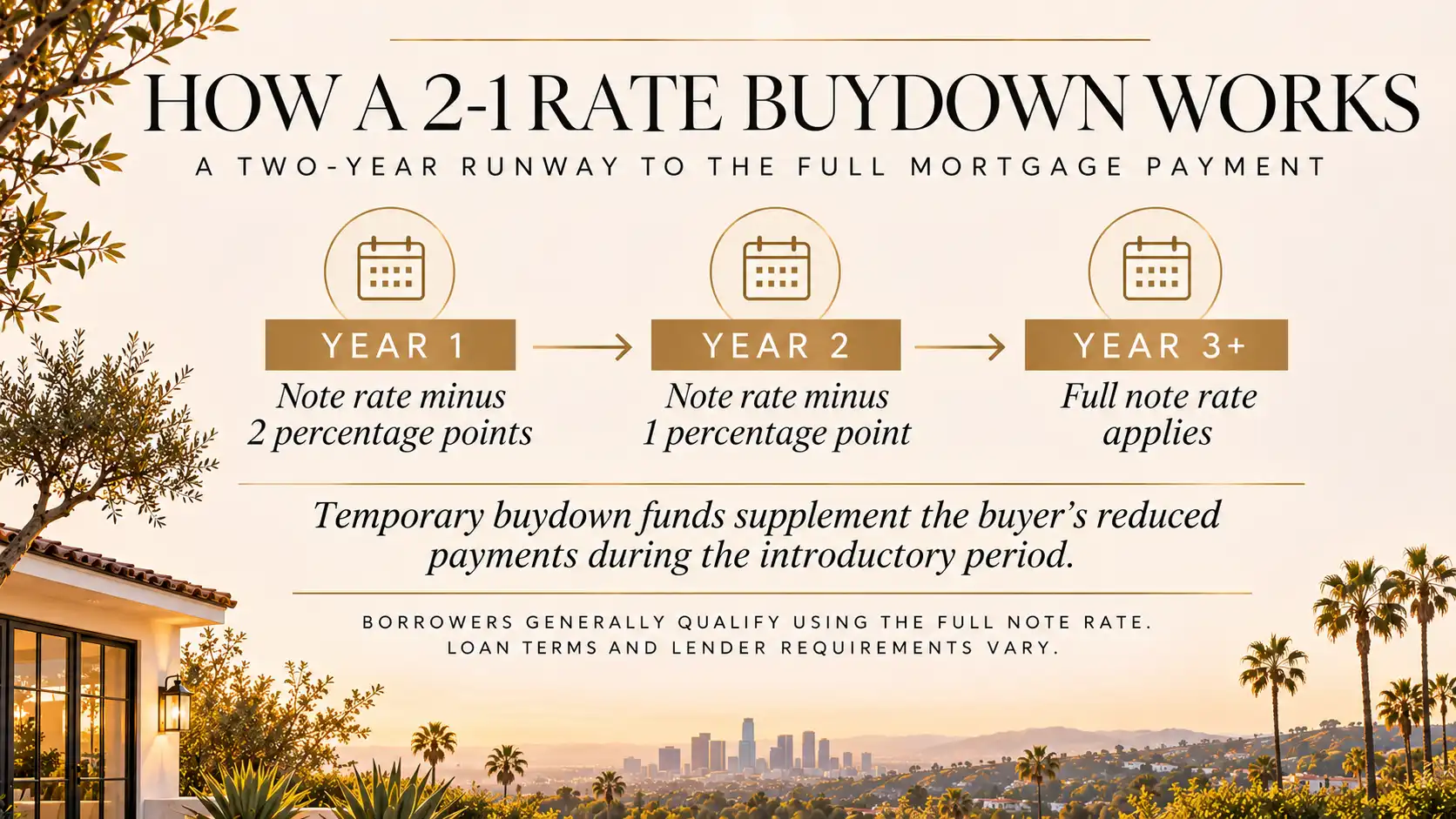
- The 2-1 Buydown: The most common structure. The interest rate is reduced by 2% in the first year and 1% in the second year. By year three, the rate returns to the original locked-in note rate for the remainder of the loan.
- The 3-2-1 Buydown: Similar to the above, but stretched over three years. The rate is 3% lower in year one, 2% lower in year two, and 1% lower in year three.
- The 1-0 Buydown: A simple 1% rate reduction for the first twelve months.
Why it works: I’ve found this strategy is highly effective for buyers who expect their income to increase, or who plan to refinance in the next couple of years once rates stabilize. It provides a comfortable “runway.”
2. The Permanent Buydown (Discount Points)
Unlike a temporary buydown, a permanent buydown lowers the interest rate for the entire 30-year life of the loan. Buyers, sellers, or a combination of both can pay for this. You are essentially paying interest upfront in the form of “points” (one point equals 1% of the loan amount).
Why it works: If a buyer plans to stay in the home for a decade or more and doesn’t want to rely on the hope of future refinancing, buying down the rate permanently offers long-term stability and predictable savings.
Buyer Considerations: Is a Buydown Right for You?
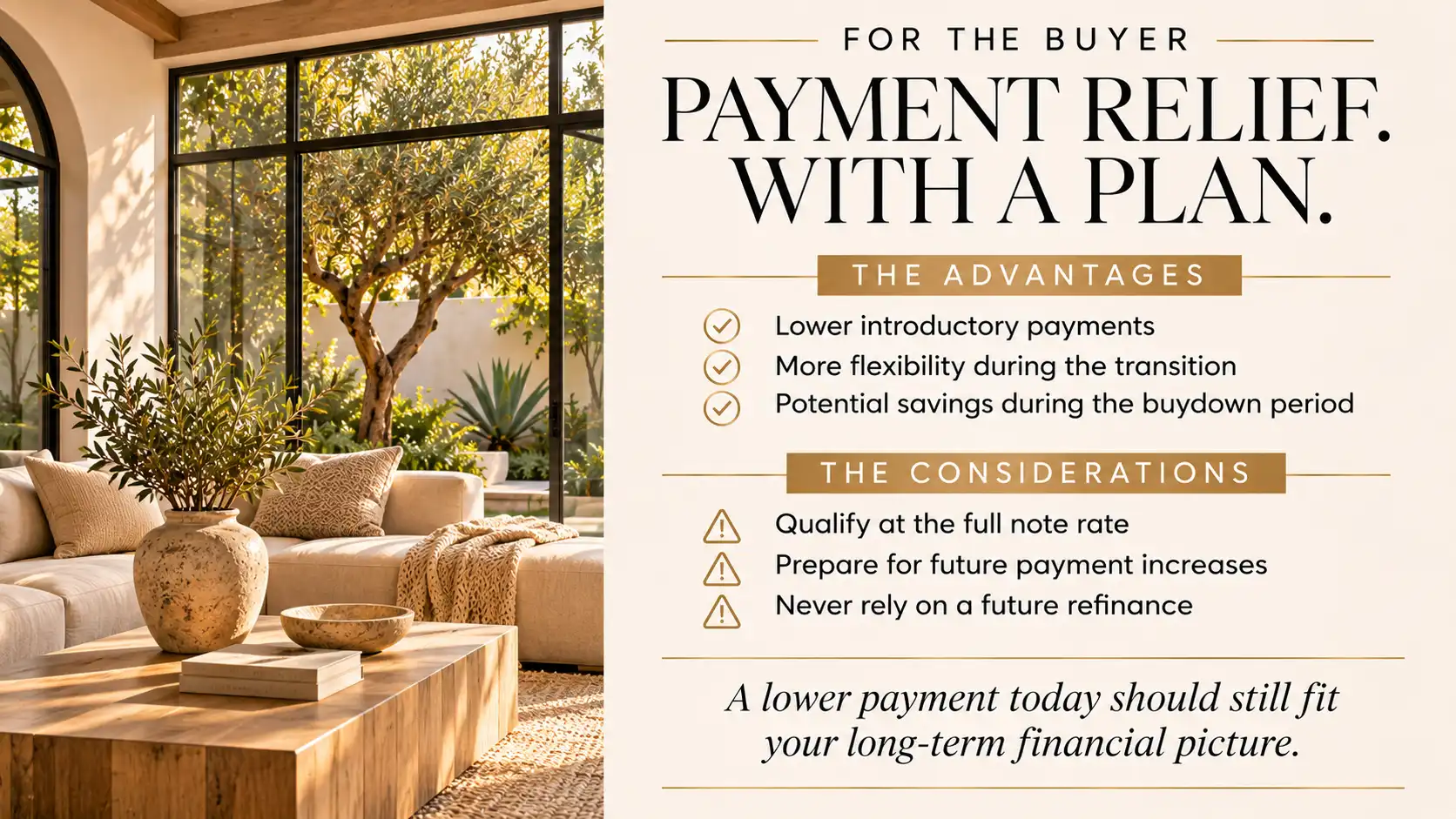
The Pros:
- Immediate Payment Relief: Temporary buydowns dramatically lower your initial housing costs, freeing up cash for moving expenses, renovations, or furnishing your new Los Angeles home.
- Easier Transition: It acts as a shock absorber against higher rates, giving you time to acclimate to your new financial picture.
- Principal Protection: If you secure a 2-1 buydown and rates drop enough to refinance in year two, you won’t lose the seller’s money. The lender applies the remaining balance in your buydown escrow account directly to your principal.
The Cons:
- Payment Shock Risk: You must be prepared to make the full mortgage payment in year three (for a 2-1 buydown) if refinancing isn’t a viable option by then.
- Qualification Standards: Lenders still require you to qualify for the loan based on the highest note rate, not the artificially lowered first-year rate. You can’t use a temporary buydown to buy more house than you can technically afford.
Seller Considerations: Leveraging Buydowns to Close the Deal
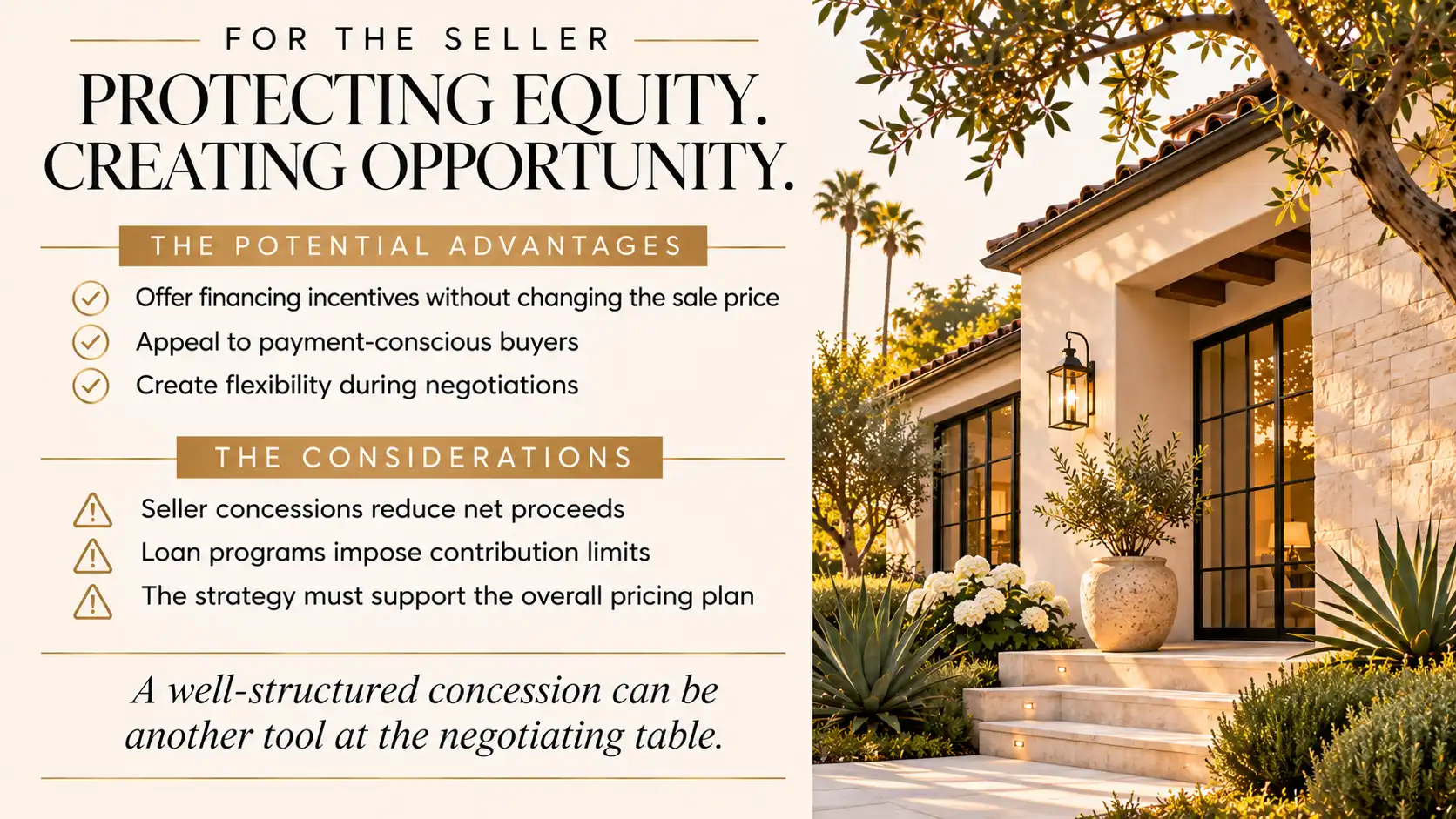
The Pros:
- Better ROI than a Price Cut: As mentioned earlier, funding a $25,000 buydown will often attract more buyers than a $50,000 price reduction, netting you more money at the closing table.
- Protecting Your Comps: In luxury markets, maintaining the recorded sale price helps protect the perceived value of your neighborhood.
- Standing Out: In a crowded market, actively advertising that you are “Offering a 2-1 Rate Buydown” in your listing remarks can make your property stand out to rate-weary buyers.
The Cons:
- Concession Limits: Lenders have strict limits on how much a seller can contribute toward a buyer’s closing costs (usually between 3% and 9% of the purchase price, depending on the loan type and down payment).
- Upfront Cost: It still requires you to give up a portion of your proceeds at closing, which requires strategic pricing from day one.
Frequently Asked Questions (FAQ)
1. What exactly is a 2-1 buydown?
It is a financing tool where the interest rate on a mortgage is reduced by 2% for the first year, 1% for the second year, and then returns to the fixed note rate for the remaining life of the loan.
2. Who typically pays for a temporary rate buydown?
In almost all cases, the seller, builder, or sometimes the lender pays for a temporary buydown in the form of a concession at closing.
3. Can a buyer pay for their own temporary buydown?
Generally, no. Fannie Mae and Freddie Mac guidelines typically require temporary buydowns to be funded by the seller or builder, though buyers can pay for permanent buydowns (discount points).
4. What happens to the buydown money if I refinance before the period ends?
This is a huge benefit. If you refinance (or sell the home) before the buydown period is over, the unused funds held in the escrow account are credited toward your principal balance. You don’t lose the money.
5. How much does a 2-1 buydown cost a seller?
It varies based on the loan amount and interest rate, but it is typically equal to the exact dollar amount of the interest savings the buyer receives over the two-year period. Usually, it equates to roughly 2% to 2.5% of the loan amount.
6. Does a buydown lower the price of the home?
No. A buydown lowers the interest rate and the monthly payment, but the purchase price of the home remains the same.
7. Can I use a buydown on a Jumbo Loan in Los Angeles?
Yes, many portfolio lenders and private banks in the luxury space offer buydown options for Jumbo loans, though the specific rules may vary slightly from conventional conforming loans.
8. Is a 3-2-1 buydown better than a 2-1 buydown?
It offers deeper savings (a 3% drop in year one) and lasts a year longer, but it is significantly more expensive for the seller to fund. It requires a larger concession limit.
9. How do I qualify for a mortgage with a temporary buydown?
Lenders will underwrite your loan based on the final, permanent note rate—not the lower introductory rate. You must prove you can afford the full payment from day one.
10. What is a permanent rate buydown?
A permanent buydown involves paying an upfront fee (discount points) to permanently lower the interest rate for the entire 30-year term of the loan.
11. Are permanent buydowns tax-deductible?
In many cases, mortgage discount points are tax-deductible in the year they are paid, but you should always consult with a licensed CPA or tax professional regarding your specific financial situation.
12. Can a seller pay for a buyer’s permanent buydown?
Yes. A seller can offer a credit at closing that the buyer applies directly toward purchasing discount points to permanently lower their rate.
13. Which is better: a permanent or temporary buydown?
It depends on your time horizon. If you plan to live in the house for 10+ years and want certainty, permanent is better. If you anticipate rates dropping and plan to refinance within 2-3 years, a temporary buydown offers a better immediate return on the seller’s concession.
14. Are buydowns allowed on investment properties?
Usually, temporary buydowns are restricted to primary residences and sometimes second homes. Permanent buydowns (points) are generally allowed on investment properties.
15. Can I negotiate a buydown after a home inspection?
Yes. Instead of asking the seller to drop the price or do repairs, you can ask for a seller credit to fund a rate buydown. It’s a highly creative way to resolve inspection negotiations.
16. Do FHA and VA loans allow buydowns?
Yes, both FHA and VA loans allow for temporary buydowns, making them excellent tools for first-time buyers or veterans.
17. Can I combine a buydown with an adjustable-rate mortgage (ARM)?
Generally, temporary buydowns are paired with fixed-rate mortgages. Pairing them with an ARM is extremely rare and often not permitted by standard lending guidelines.
18. Who holds the money for a temporary buydown?
The funds are kept by the lender in an escrow account and disbursed monthly to make up the difference between the buyer’s reduced payment and the actual required mortgage payment.
19. What happens in year three of a 2-1 buydown?
Your monthly payment will adjust to the fully amortized amount based on your original locked-in note rate. It will remain at this fixed amount for the remaining 28 years unless you refinance.
20. Why would a seller agree to this instead of just dropping the price?
Because a $20,000 concession for a buydown costs the seller less out-of-pocket than a $50,000 price drop, while providing the buyer with a much more noticeable reduction in their monthly payment. It protects the seller’s bottom line.
Closing Perspective
Real estate transitions rarely happen in perfect economic conditions. There will always be headwinds—whether it’s inventory shortages, fluctuating rates, or shifting buyer sentiment. But in my experience, the space between what a buyer can afford and what a seller expects is where true advisory strategy comes into play.
Interest rate buydowns aren’t a gimmick; they are a highly functional financial bridge. By focusing on the math of the monthly payment rather than the ego of the purchase price, both parties can walk away from the closing table feeling secure in their investment. You don’t have to wait for the market to be perfect; you just need to be intentional about how you structure the deal.
Let’s Plan Your Next Move
Whether you’re preparing to list your property and want to position it attractively in a rate-sensitive market, or you’re a buyer trying to optimize your purchasing power in Los Angeles, having a clear strategy is essential. Reach out today to schedule a Strategy Consultation, and let’s explore how we can tailor these tools to your specific goals.
Melissa Menard REALTOR® | Compass
Los Angeles & Surrounding Areas
📞 310.729.9726 | DRE# 01858710
📧 melissa@melissamenardhomes.com
🌐 www.MelissaMenardHomes.com
Disclaimer: The information provided in this post is intended for educational purposes only and should not be considered financial, legal, tax, or investment advice. Real estate laws, market conditions, and regulations change over time. Please consult the appropriate licensed professionals regarding your specific situation. All content should comply with applicable Fair Housing laws and regulations.