

Whether you own a single condo or an apartment building, sit on a condo HOA board, or if you’re looking to buy or sell a condo or multi-unit property in Los Angeles this year, there is a massive compliance issue you can no longer afford to ignore.
The deadlines for California’s landmark balcony inspection laws—Senate Bill 721 and Senate Bill 326—have officially passed. What was once a distant blip on the horizon is now a strict legal reality, and the consequences of non-compliance are already disrupting real estate escrows, triggering daily fines, and exposing property owners to severe legal liability.
As a Los Angeles REALTOR®, I believe in keeping my clients ahead of the curve so that they can negotiate from a position of strength and protect their equity. Whether you are navigating the sale of a legacy multifamily asset in the South Bay, purchasing a luxury condo in West L.A., or managing an HOA in the Valley, understanding these laws is critical to your financial strategy in today’s shifting market.
For a detailed legal overview of your requirements, I highly recommend reviewing the California Homeowners Association’s official legal overview as well as engineering analyses provided by firms like Rimkus.
FAST FACTS: What You Need to Know in 2026
- The Laws: SB 721 (Apartments) and SB 326 (Condos/HOAs) require mandatory structural inspections of wood-framed Exterior Elevated Elements (EEEs).
- The Deadlines (Passed): The initial inspection deadline for SB 326 (Condos) was January 1, 2025. The deadline for SB 721 (Multifamily), extended by AB 2579, was January 1, 2026.
- The Scope: Applies to balconies, decks, stairways, and walkways that are more than 6 feet above ground level and rely on wood or wood-based products for structural support.
- The Penalties: Non-compliance can trigger civil penalties ranging from $100 to $500 per day, potential building safety liens, and extreme liability in the event of an accident.
- The Cycle: Inspections must be repeated every 6 years for apartments (SB 721) and every 9 years for condos (SB 326).
The Origin: Why California Took Unprecedented Action
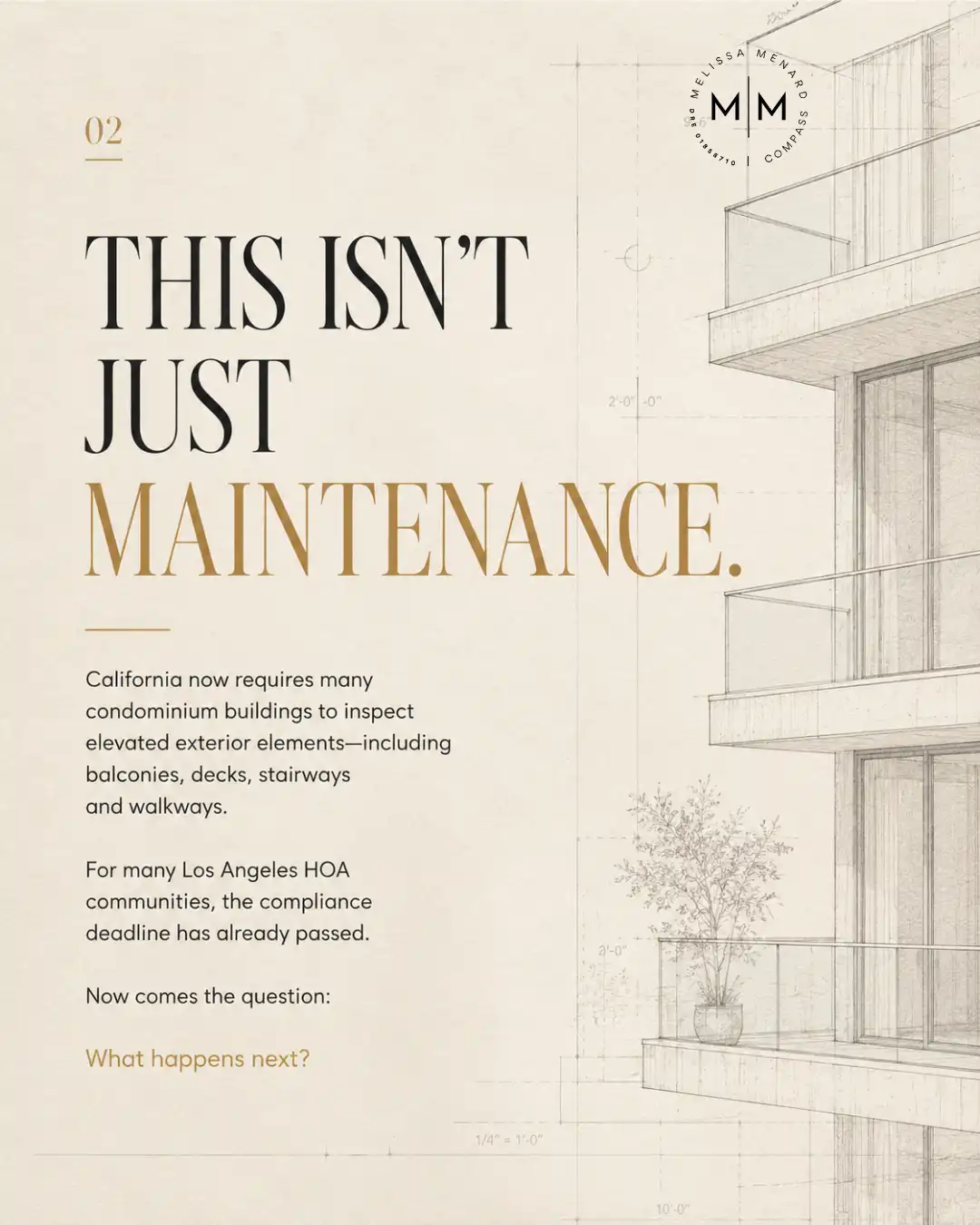
California’s balcony laws weren’t created in a vacuum. They were born out of a devastating tragedy. In June 2015, a wood-framed balcony in Berkeley collapsed during a birthday party, resulting in six fatalities and several severe injuries.
Subsequent structural analysis revealed a chilling truth: the balcony’s wooden support framing was entirely hollowed out by dry rot. The waterproofing seal had failed, allowing moisture from coastal rain and fog to seep into the concealed spaces. Because the damage was completely hidden from view, no one knew the structure was compromised until it was too late.
In response, state lawmakers realized that casual visual checks by property owners were insufficient. The legislature passed SB 721 in 2018 and SB 326 in 2019, shifting the burden to mandatory, cyclical inspections performed by licensed engineering and architectural professionals. The goal is simple: catch waterproofing failures and dry rot before they cause catastrophic structural failure.
SB 721 vs. SB 326: Which Law Applies to Your L.A. Property?
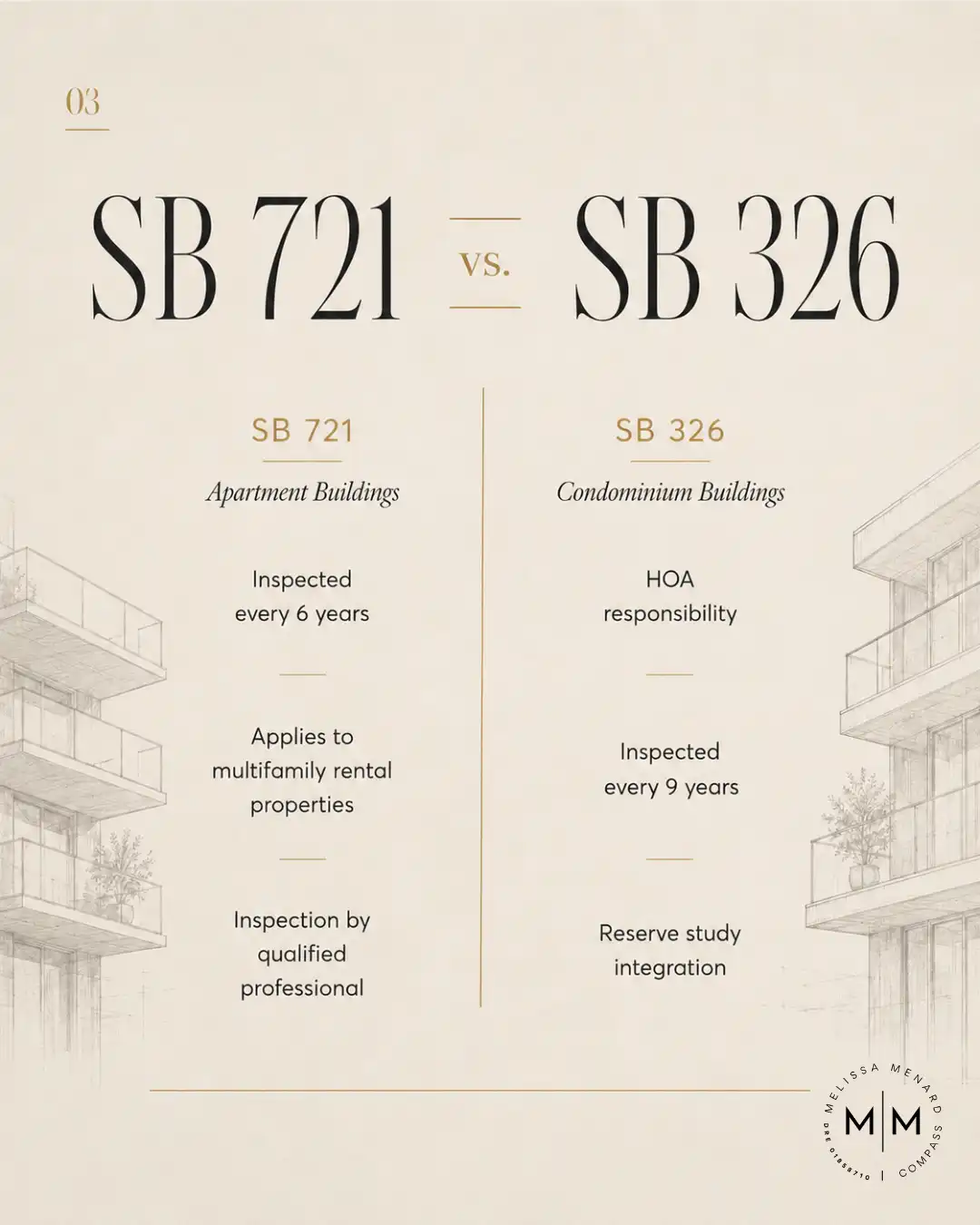
While the intent of both laws is identical, the application depends entirely on how your property is legally classified. Here is the breakdown for Los Angeles owners:
1. Senate Bill 721: The Apartment Law
- Target: Multifamily residential buildings with 3 or more dwelling units (e.g., triplexes, fourplexes, and large apartment communities).
- The Deadline: Originally set for 2025, AB 2579 extended this to January 1, 2026. This deadline has now passed.
- Inspection Scope: The law requires an inspector to examine a representative sample of at least 15% of each type of elevated exterior element (balconies, stairs, walkways).
- Who Can Inspect: Licensed architects, civil or structural engineers, or general contractors (holding A, B, or C-5 licenses) with at least five years of experience in multistory wood-frame construction.
2. Senate Bill 326: The Condominium & HOA Law
- Target: Condominium projects and Common Interest Developments governed by a Homeowners Association (HOA).
- The Deadline: January 1, 2025. This deadline has passed.
- Inspection Scope: Much stricter than the apartment law. SB 326 requires a “statistically significant sample” that achieves a 95% confidence level with a 5% margin of error, meaning a much higher volume of balconies must be opened and inspected.
- Who Can Inspect: Strictly limited to licensed structural engineers, civil engineers, or architects. Contractors are not permitted to certify SB 326 inspections.
The L.A. Real Estate Impact: Buying, Selling, and Escrow in 2026
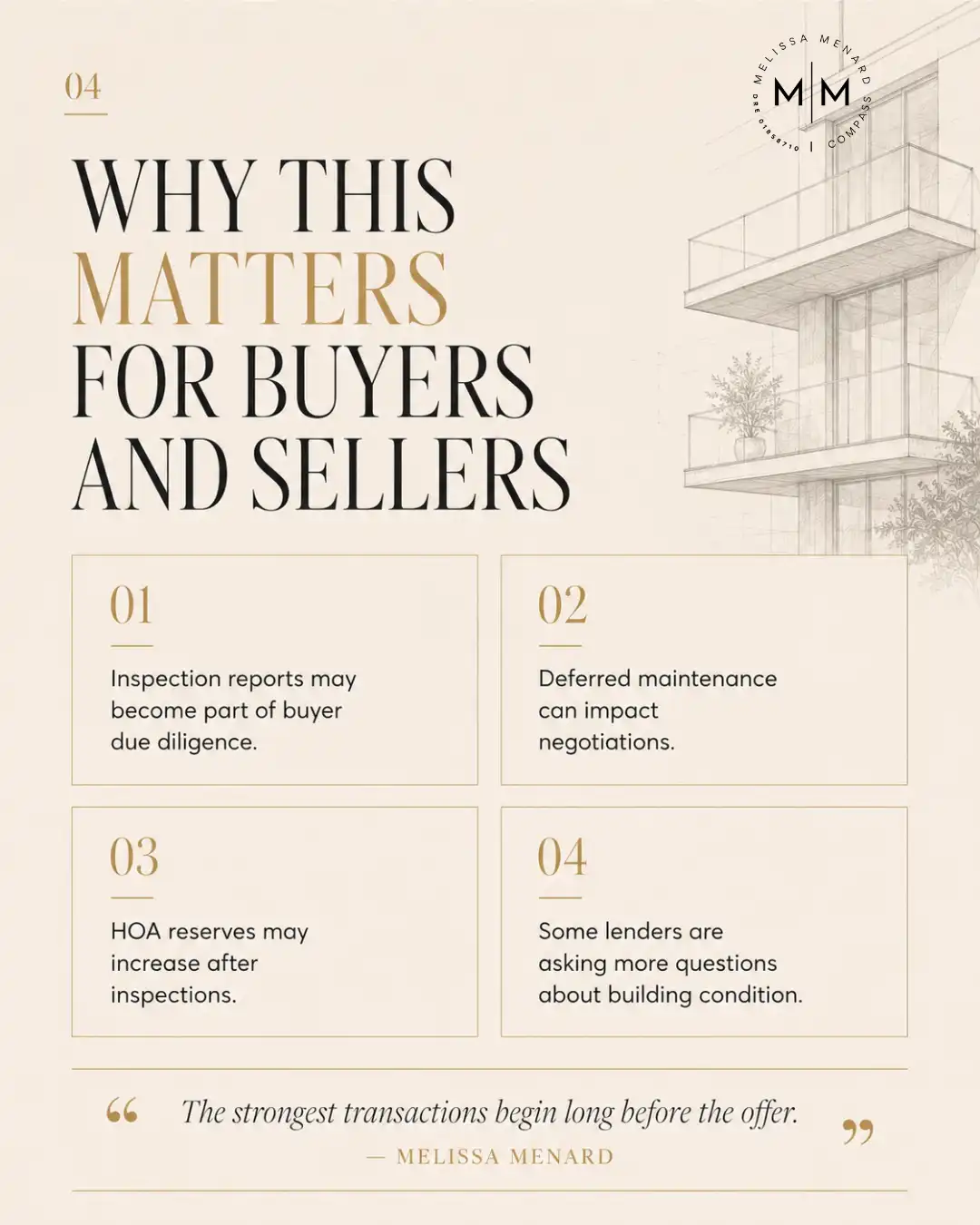
We are currently navigating a highly nuanced real estate market in Los Angeles. Inventory remains remarkably tight across Southern California, yet buyers are incredibly discerning due to elevated borrowing costs. The expiration of these compliance deadlines has introduced a major friction point into real estate transactions. Here is a deep-dive analysis of how this affects your local strategy.
How Current Interest Rates Compound Compliance Costs
In a market where mortgage interest rates hover higher than the historical lows of the early 2020s, affordability is stretched. When an L.A. buyer is already financing a property at current rates, the last thing they can absorb is a massive, unexpected post-close capital expense.
For buyers purchasing an uninspected multifamily property, the math simply doesn’t work. If an SB 721 inspection reveals severe dry rot necessitating $50,000 in immediate structural repairs, the buyer cannot easily roll that into their financing. This means buyers are heavily discounting their offers on non-compliant properties, or demanding that sellers place large sums of money in escrow holdbacks to cover the unknown risks.
Local Inventory and the Premium on Turn-Key Properties
The L.A. housing supply remains constrained. However, because buyers are price-sensitive, there is a massive bifurcation in the market. Fully compliant, turn-key properties—where the SB 721 or SB 326 reports are completely clear and signed off—are trading at an absolute premium. They are receiving multiple offers because they offer peace of mind. Conversely, properties sitting with deferred maintenance or expired balcony deadlines are lingering on the market, eventually suffering price reductions.
Neighborhood Nuances: From the Valley to the South Bay
The location of your L.A. property dictates the likelihood of hidden balcony damage:
- Coastal Markets (Santa Monica, Venice, South Bay): Properties west of the 405 face relentless exposure to the marine layer. Salt-heavy moisture accelerates the degradation of waterproofing membranes and metal fasteners, making dry rot incredibly prevalent in coastal wood-framed structures.
- Inland Markets (San Fernando Valley, Pasadena): While they lack the marine layer, Valley properties deal with extreme summer heat. UV exposure and thermal expansion can cause balcony decking and elastomeric coatings to crack, allowing water intrusion during our intense, short-burst winter rainstorms.
For Sellers and Landlords
If you are planning to sell a multi-unit property or an older condo in Los Angeles, you cannot hide from these laws. When you list a property, the inspection report (or the glaring lack of one) becomes a material fact that must be disclosed to potential buyers. If you attempt to sell an apartment building that has not undergone its SB 721 inspection, savvy buyers will immediately use that non-compliance as aggressive leverage. They will assume the worst—hidden dry rot and massive repair bills—and will either walk away or demand heavy price reductions.
The cleanest, most profitable path to the closing table is to front-load your compliance. Complete the inspection, secure the report, and address any “blue” (maintenance) or “red” (emergency) findings before hitting the market. A clean inspection report is now a highly valuable marketing asset that protects your asking price.
For Los Angeles Homebuyers and Investors
If you are buying into an HOA or purchasing a multifamily investment property, your due diligence period is your safety net.
- Buying a Condo: You must heavily scrutinize the HOA documents. Ask directly: Has the SB 326 inspection been completed? What were the findings? If the HOA missed the 2025 deadline, they are non-compliant, and the structural integrity of the complex is an unknown. Furthermore, if severe repairs are needed, the HOA will likely pass those costs onto owners via a massive special assessment—sometimes reaching $30,000 to $50,000 per household. Do not buy into another community’s deferred maintenance.
- Buying an Apartment Building: Demand the SB 721 inspection report upfront. If the seller missed the 2026 deadline, you are inheriting an active liability and potential daily fines from the local building department. Factor the cost of immediate inspections and potential structural repairs into your underwriting and offer price.
For HOA Boards
If your HOA has not yet completed its SB 326 inspection, you are in a precarious legal position. Local architectural and engineering firms are experiencing massive backlogs, with wait times stretching into months. Every month of delay increases your exposure to liability. Prioritize this immediately, and communicate transparently with your homeowners about the reserve funds required to cover the inspection and any subsequent repairs.
The Financial Stakes: Fines, Liens, and Liability
The cost of an inspection is a fraction of the cost of ignoring the law. Under SB 721, if an inspector finds conditions requiring repair and the owner fails to comply within the statutory timeline (typically 120 days for permits, plus 120 days for construction), local enforcement agencies can levy severe penalties.
Fines range from $100 to $500 per day. Over a single year, that can equate to $182,500 in civil penalties. Furthermore, the city has the authority to place a building safety lien on the property, which will freeze your ability to sell or refinance until the debt is paid and the property is brought up to code.
Most importantly, consider the human cost. These laws exist to prevent the loss of life. The legal and moral liability of an uninspected balcony collapse in 2026—when the laws and deadlines are universally known—is unquantifiable.
Next Steps for L.A. Owners and Buyers
The deadlines are behind us, but the path forward is clear.
- Assess Your Portfolio: Identify any properties you own with wood-framed balconies, decks, or stairways over 6 feet high.
- Hire a Qualified Professional: Do not hire a standard home inspector. Ensure you are contracting with the specific licensed architects, engineers, or contractors mandated by the respective bills.
- Consult Your Real Estate Advisor: If you are considering selling a non-compliant property, let’s strategize. We can structure your listing to account for these hurdles while protecting your equity.
Real estate in Los Angeles is about maximizing opportunity while mitigating risk. Let’s make sure your investments remain secure, compliant, and highly valuable.
Frequently Asked Questions (FAQ)
1. I missed the deadlines for SB 721 and SB 326. What happens now?
Both the Jan 1, 2025 (Condos) and Jan 1, 2026 (Apartments) deadlines have passed. You are currently out of compliance. You must schedule an inspection immediately to stop potential daily fines ($100-$500/day) and mitigate liability.
2. Can I sell my L.A. apartment building if the SB 721 inspection isn’t done?
Yes, but the lack of an inspection is a material fact that must be disclosed to the buyer. It will severely hurt your negotiating power, as buyers will likely ask for large credits to cover the unknown risks and inspection costs.
3. Does this law apply to my single-family home in Los Angeles?
No. Both SB 721 and SB 326 specifically target multi-unit properties (3 or more units). Single-family homes and duplexes are currently exempt.
4. My apartment building’s balconies are 100% concrete and steel. Do I need an inspection?
No. The laws specifically target exterior elevated elements that rely “in whole or in part on wood or wood-based products” for structural support. Fully concrete and steel structures are exempt.
5. What is considered an “Exterior Elevated Element” (EEE)?
An EEE is any balcony, deck, porch, stairway, walkway, or landing that extends beyond the exterior walls, is exposed to the weather, has a walking surface more than 6 feet above ground level, and relies on wood framing.
6. Do ground-floor patios require inspection?
No. If the walking surface is not more than 6 feet above the adjacent grade (ground level), it does not fall under these specific bills.
7. I own a townhome. Who is responsible for the balcony inspection?
It depends on how your community is legally defined (Planned Development vs. Condominium) and your HOA’s CC&Rs. If you own the structure and the lot, you are generally responsible. If the HOA is responsible for exterior maintenance, it falls under SB 326.
8. How much does an SB 326 inspection cost for an HOA?
Costs vary wildly based on complex size and design, but typical base inspections for medium-sized complexes can range from $15,000 to $40,000+, not including any required destructive testing or repairs.
9. Will the inspector have to rip open my walls or ceilings?
Often, yes. The laws require inspectors to assess the underlying structural wood and waterproofing. If there are no existing ventilation vents, they will need to perform “destructive testing” (cutting holes) to see inside the enclosed soffits.
10. What happens if the inspector finds a problem?
The inspector will categorize the issue. “Red” indicates an immediate life-safety hazard, requiring you to block access to the balcony and perform emergency repairs immediately. “Blue” indicates non-emergency maintenance, giving you 120 days to pull permits and 120 days to complete work.
11. Who can perform an SB 721 inspection for my apartment building?
Licensed architects, civil/structural engineers, or general contractors (A, B, or C-5) with 5+ years of multistory wood-frame experience.
12. Can a general contractor perform an SB 326 condo inspection?
No. The rules for condos are stricter. Only licensed architects, structural engineers, or civil engineers can perform SB 326 inspections.
13. Are these inspections a one-time thing?
No, they are cyclical. Apartment buildings (SB 721) must be re-inspected every 6 years. Condo HOAs (SB 326) must be re-inspected every 9 years.
14. What happens if an owner refuses to fix a damaged balcony?
The local enforcement agency can issue daily fines ($100-$500), file a building safety lien against the property, and pursue other legal administrative actions to force compliance.
15. If I am buying an L.A. condo, what specific document should I ask for?
Ask your agent to request the “SB 326 Exterior Elevated Elements Inspection Report” from the HOA, alongside the standard Reserve Study. Review it carefully for deferred maintenance.
Ready to Navigate the L.A. Market with Confidence?
Whether you are dealing with deferred maintenance or ready to list a fully compliant, pristine property, you need a strategist in your corner.

Melissa Menard REALTOR® | Compass
Los Angeles & Surrounding Areas
📞 310.729.9726 | DRE# 01858710
📧 melissa@melissamenardhomes.com
🌐 www.MelissaMenardHomes.com
Disclaimer: The information provided in this post is for educational purposes only and does not constitute financial, legal, or investment advice. Market conditions are subject to change. Please consult with a qualified professional regarding your specific real estate needs and local Fair Housing regulations.