


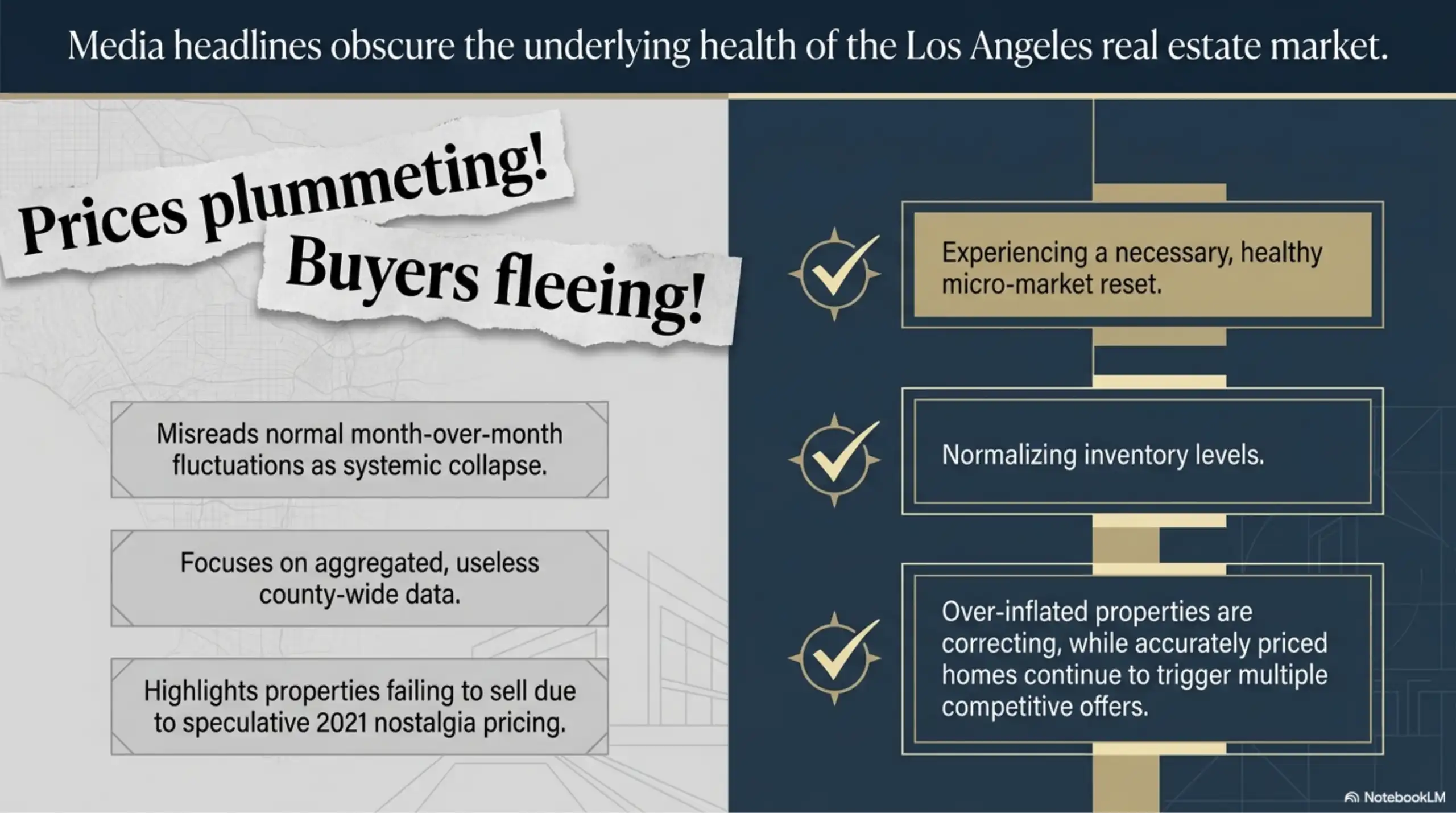
The headlines across Southern California are shouting for your attention. Turn on the news or scroll through your feed, and you will see a barrage of warnings: “LA Home Prices Take a Major Dive,” “Buyers Backing Out in LA,” or “Is the LA Housing Market Broken?” It is enough to make any homeowner panic and any prospective buyer freeze in their tracks.
But if you look past the sensationalized clickbait and study the actual localized data, a completely different story emerges. The Los Angeles housing market is not crashing. Instead, we are witnessing a highly anticipated, much-needed market correction—a micro-market reset driven by strategic pricing, shifting buyer leverage, and normalizing inventory.
When macroeconomic factors shift, bad pricing gets exposed, but well-priced homes continue to attract steady buyer activity and multiple offers. Let’s break down exactly what is happening across Los Angeles neighborhoods right now, separating historical fact from media fiction.
FAST FACTS: LA Market Realities at a Glance
- A Reset, Not a Collapse: Unlike the structural economic collapse of 2008, today’s Los Angeles market is experiencing a stabilization or “normalization” phase. Widespread panic selling and systematic asset devaluations are virtually non-existent.
- Strategic Pricing Wins: Homes priced accurately according to current micro-market data are still selling rapidly, frequently triggering competitive multiple-offer scenarios.
- Increased Buyer Leverage: Prospective buyers in Southern California enjoy expanded choices, increased room for negotiation, and contingencies that were impossible to secure during the post-pandemic frenzy.
- Inventory Shifts: While overall county-wide inventory remains historically tight compared to pre-2020 averages, selective neighborhood pockets are experiencing localized inventory growth, requiring nuanced local expertise.
- Strong Economic Foundations: High home equity, strict lending requirements over the last decade, and persistent regional demand keep L.A.’s core real estate fundamentals remarkably secure.
The Media Illusion vs. Southern California Reality
To understand why the L.A. housing market is remarkably resilient, we must first analyze the fundamental differences between a market crash and a market correction.
+-----------------------------------------------------+---------------------------------------------------+
|                   MARKET CRASH                      |                 MARKET CORRECTION                 |
+-----------------------------------------------------+---------------------------------------------------+
| • Widespread panic selling & surging foreclosures   | • Selective, strategic price adjustments           |
| • Sharp, systemic collapse in underlying values      | • Well-priced homes continue to sell steadily      |
| • High macroeconomic unemployment & layoffs          | • Healthy buyer demand remains active             |
| • Extreme credit tightening & capital freezes       | • Inventory and market paces normalize            |
| • Pervasive economic contraction across sectors     | • Long-term underlying fundamentals stay strong   |
+-----------------------------------------------------+---------------------------------------------------+
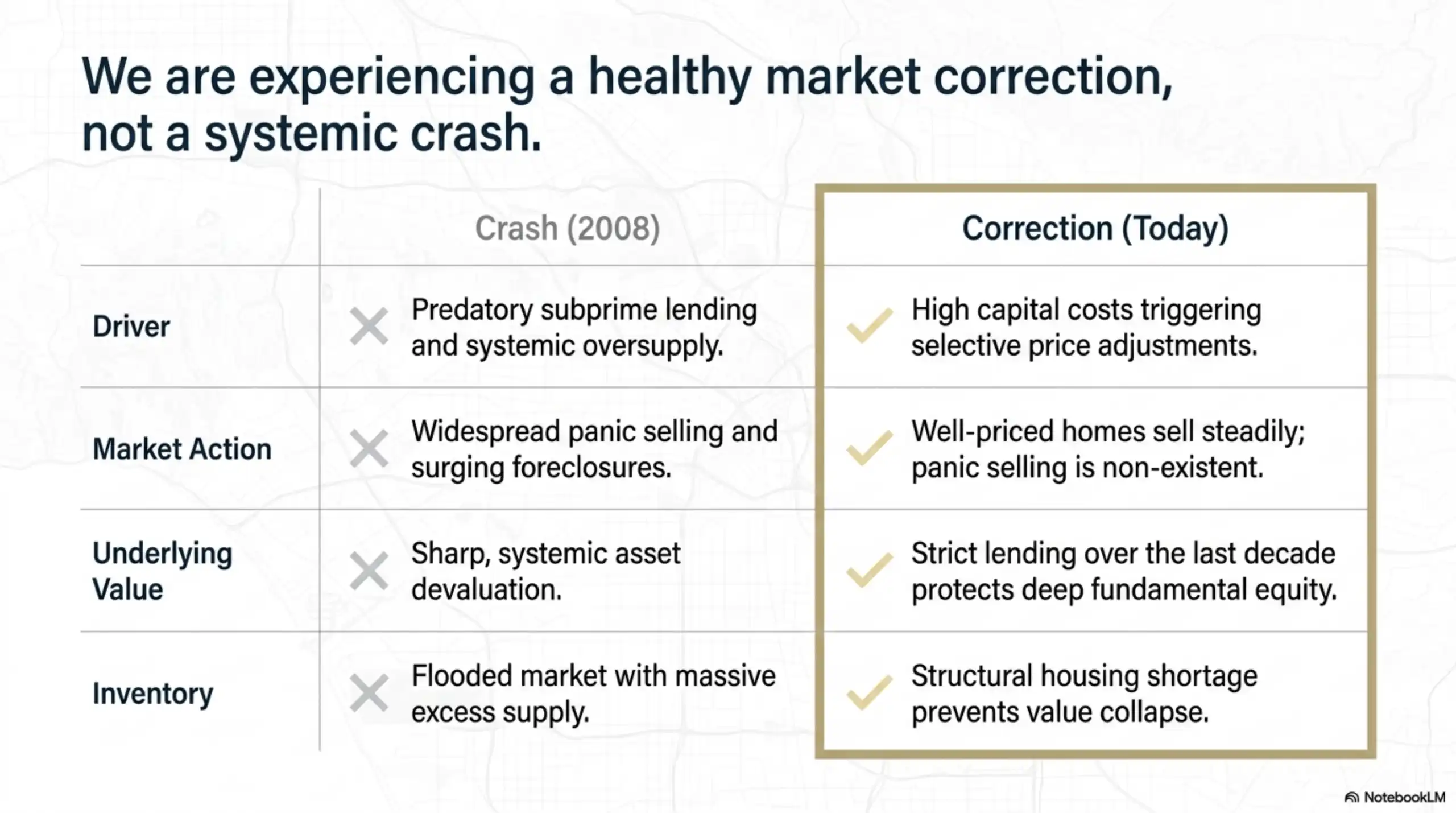
When the media broadcasts that “home values are on the decline across LA County,” they are typically looking at aggregated, macro-level data or misleading month-over-month fluctuations. They gloss over the fact that over-inflated properties—those priced using speculative 2021 numbers—are simply undergoing essential price corrections.
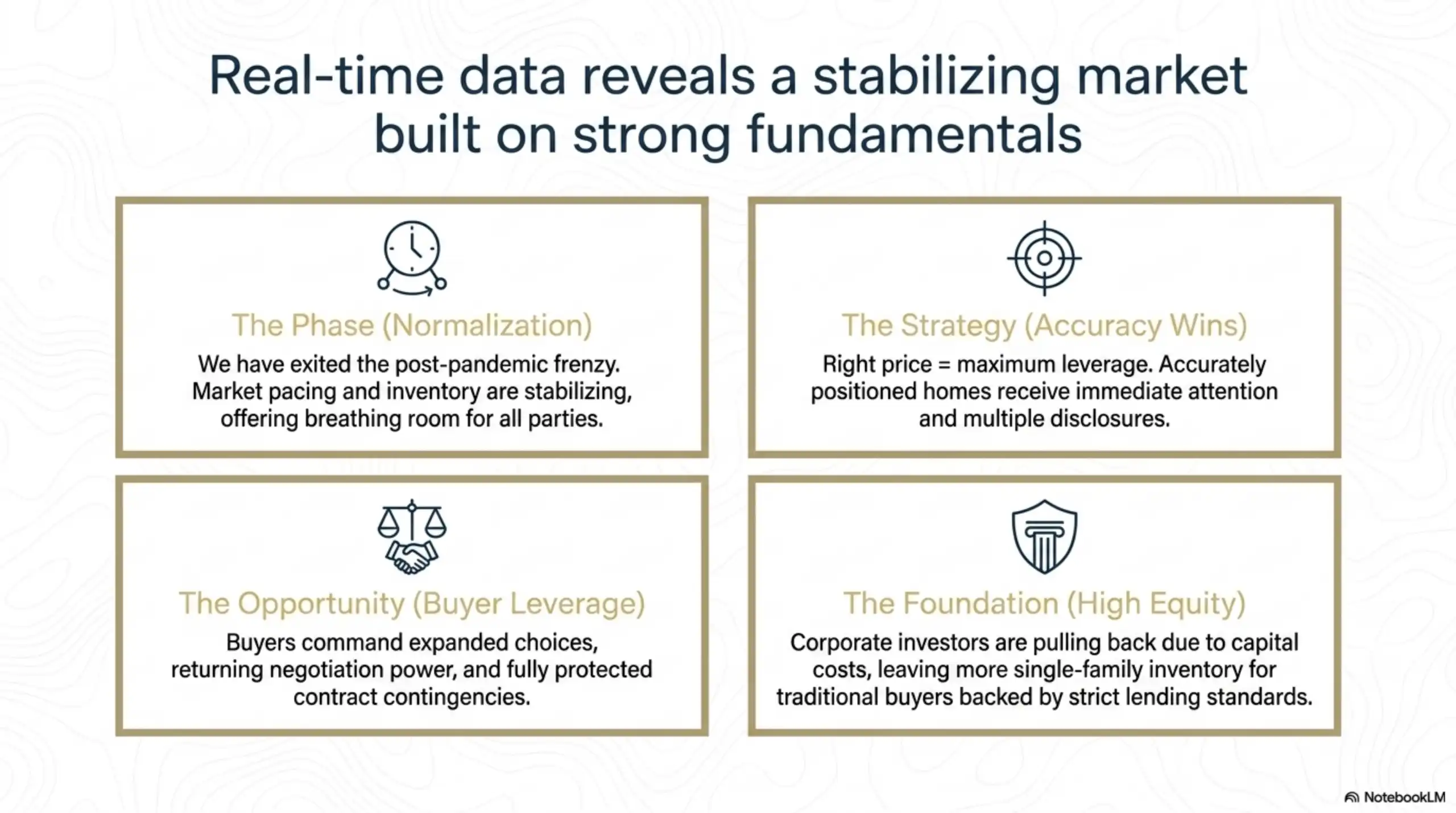
In a true crash, everything goes down regardless of quality or location because the financial system lacks liquidity. In our current Los Angeles market, the right home at the right price still commands immediate attention, multiple disclosures, and top dollar.
Seller Strategy: Pricing Right Matters More Than Ever
If you are preparing to sell a property in Los Angeles, your strategy cannot rely on guesswork, nostalgia, or what your neighbor’s house sold for eighteen months ago. In a normalizing market, buyers are highly sensitive to overpricing.
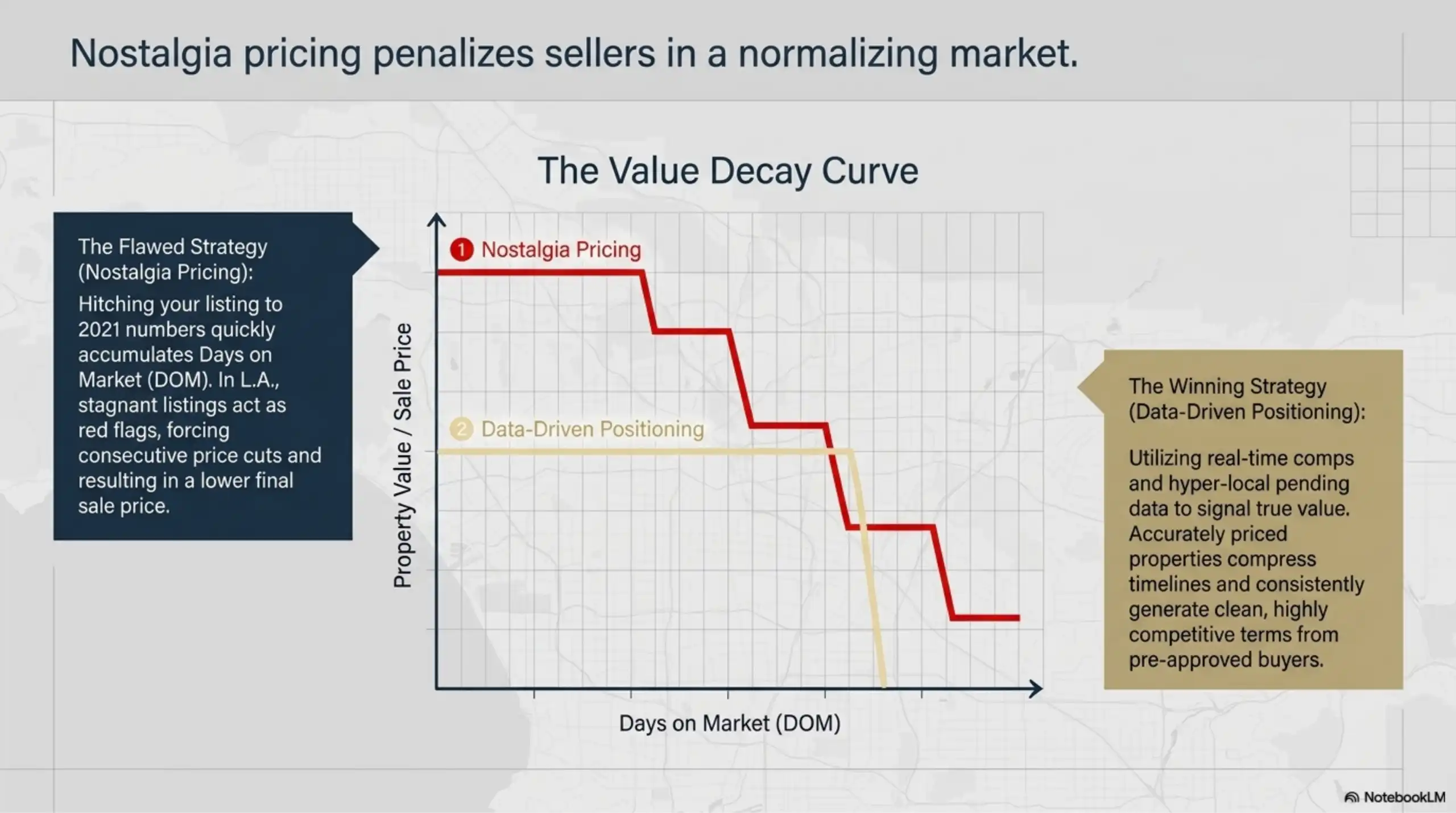
The Cost of Overpricing
When a property hitches its wagon to an unrealistic initial asking price, it quickly accumulates days on market (DOM). In L.A.’s real estate culture, a stagnant listing acts as a red flag. Buyers assume something is physically or structurally wrong with the home, eventually forcing the seller to execute consecutive price cuts. This often results in selling the asset for less than what it would have commanded had it been priced accurately from day one.
The Power of Data-Driven Positioning
A sophisticated market strategy relies on real-time comps, pending data, and current hyper-local inventory levels. By positioning your luxury or luxury-adjacent property accurately within the current market environment, you signal value to active, pre-approved buyers. The data continuously shows that appropriately positioned properties attract strong buyer pools, compress timelines, and consistently generate clean, highly competitive terms.
Buyer Opportunity: More Options, More Negotiation, More Leverage
For years, purchasing real estate in Los Angeles felt like an uphill battle. Buyers were forced to waive appraisal contingencies, ignore physical home inspections, match astronomical seller rent-backs, and endure stressful bidding wars against dozens of competing offers.
Today, the pendulum is finding its balance. While we are not in a buyers’ market by traditional definitions, buyers finally possess meaningful leverage.
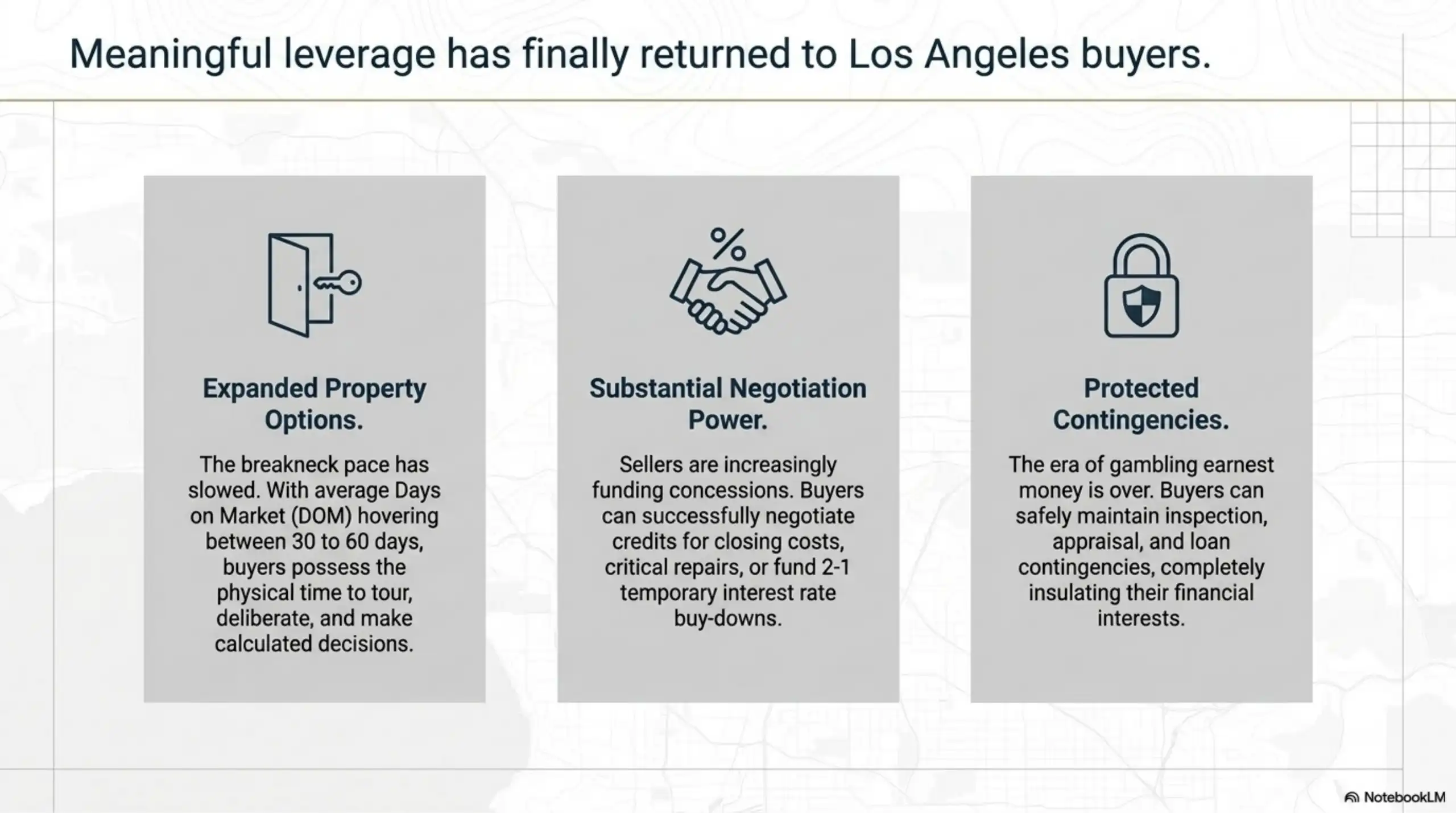
- Expanded Property Options: With homes taking a bit longer to transition from active to pending status, you have the physical time to tour properties, deliberate with your family, and make calculated decisions.
- Substantial Room for Negotiation: Sellers are proving increasingly willing to offer credits for recurring and non-recurring closing costs, fund interest rate buy-downs (such as 2-1 temporary buy-downs), and address critical repair items discovered during inspections.
- Protection of Contingencies: You no longer have to gamble with your earnest money deposit. Buyers can comfortably maintain their inspection, appraisal, and loan contingencies to ensure their financial interests remain fully insulated.
Navigating Local L.A. Interest Rates and Inventory Dynamics
We cannot discuss the Los Angeles real estate landscape without addressing the twin pillars driving our current market shift: interest rates and inventory.
The Interest Rate Landscape
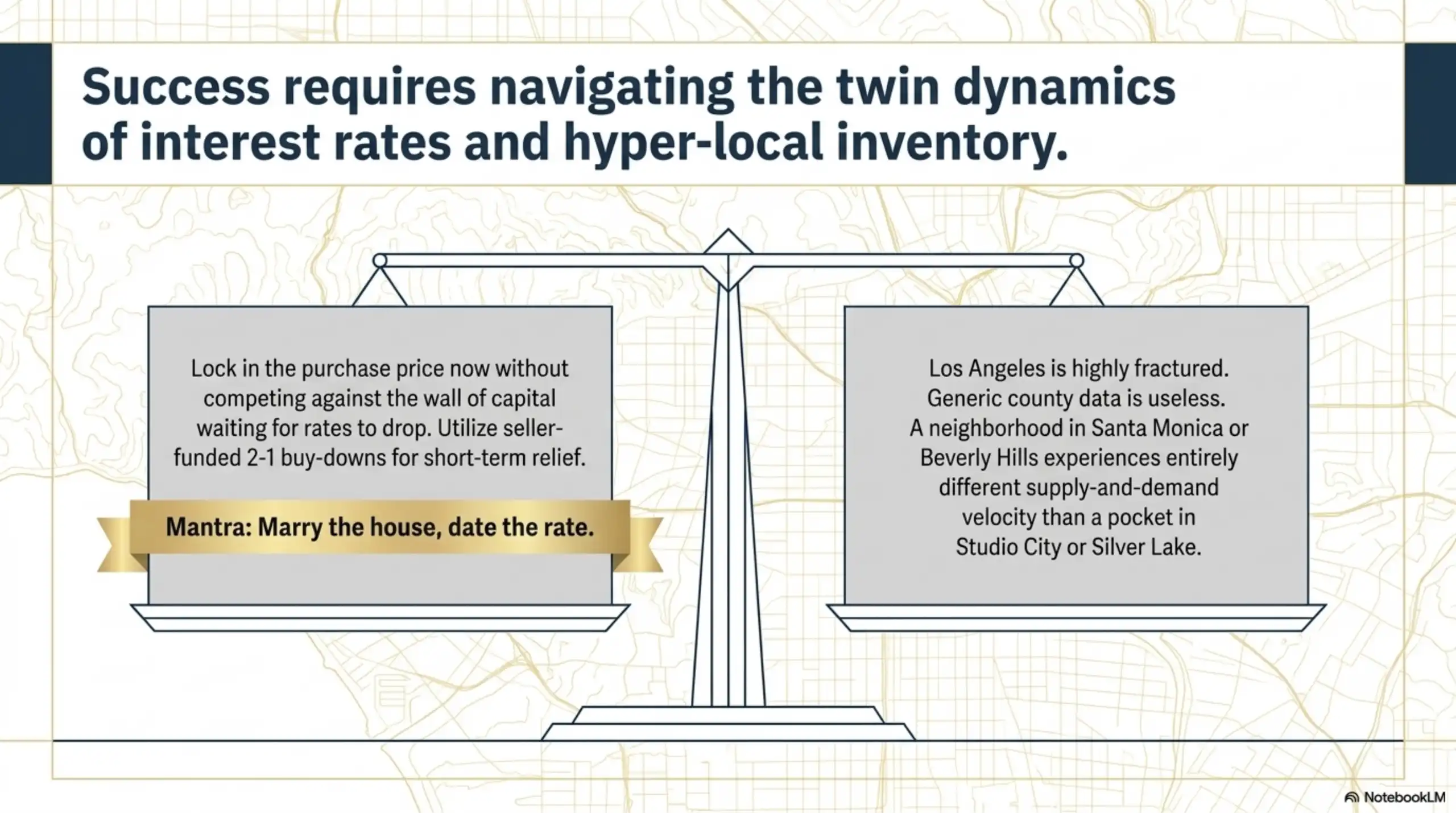
While mortgage rates remain elevated compared to the historic, anomalous lows of the pandemic era, buyers and sellers are adapting to this new normal. Sophisticated buyers recognize that purchasing a home now allows them to lock in a purchase price without competing against the wall of capital that will inevitably re-enter the market the moment rates drop. The prevailing mantra remains mathematically sound: Marry the house, date the rate.
The Micro-Market Inventory Factor Inventory in Los Angeles is highly fractured. A neighborhood in Santa Monica or Beverly Hills might experience completely different supply-and-demand velocity than a pocket in Studio City, Silver Lake, or the South Bay. This structural fragmentation is why generic county or national news reports fail to provide actionable insights. Understanding structural changes in your specific zip code is the only reliable method for predicting equity trajectory.
Frequently Asked Questions (FAQ)
1. Is the Los Angeles housing market going to crash like it did in 2008?
No. The 2008 crash was triggered by systemic predatory lending practices, subprime mortgage products, and an oversupply of inventory. Today’s market features exceptionally strict lending standards, historically low default rates, and an ongoing, organic structural housing shortage in Southern California that prevents values from collapsing.
2. Why are we seeing so many price cuts on Zillow and Redfin?
Price cuts are a sign of misaligned seller expectations, not a market crash. Many sellers initial list their homes using outdated pricing strategies. When the market rejects that price, an adjustment occurs to match real-time buyer demand.
3. Are well-priced homes still receiving multiple offers in L.A.?
Absolutely. Properties that are accurately priced, beautifully presented, and strategically marketed routinely receive multiple competitive offers within their first two weeks on the market.
4. How long does it take to sell a home in Los Angeles right now?
The average days on market (DOM) has lengthened compared to the breakneck pace of recent years, now hovering between 30 to 60 days depending on the price point, property condition, and specific micro-neighborhood.
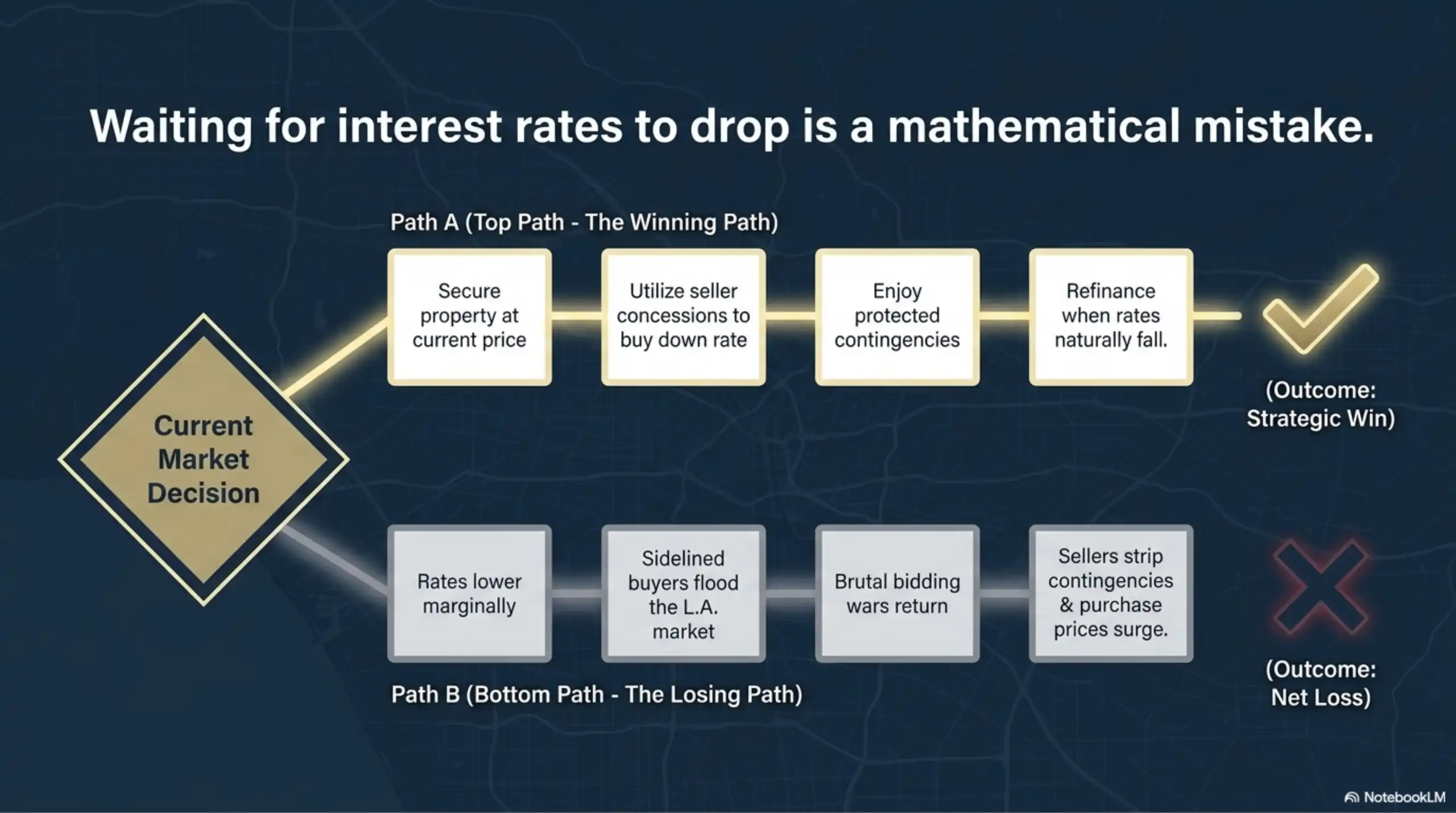
5. Should I wait for interest rates to drop before buying a home?
Waiting can be a costly strategy. When interest rates drop, a wave of sidelined buyers will return to the market, driving home prices up through renewed competition. Buying now allows you to negotiate on price and terms without fierce competition, with the option to refinance later.
6. What neighborhoods in L.A. are holding their value best?
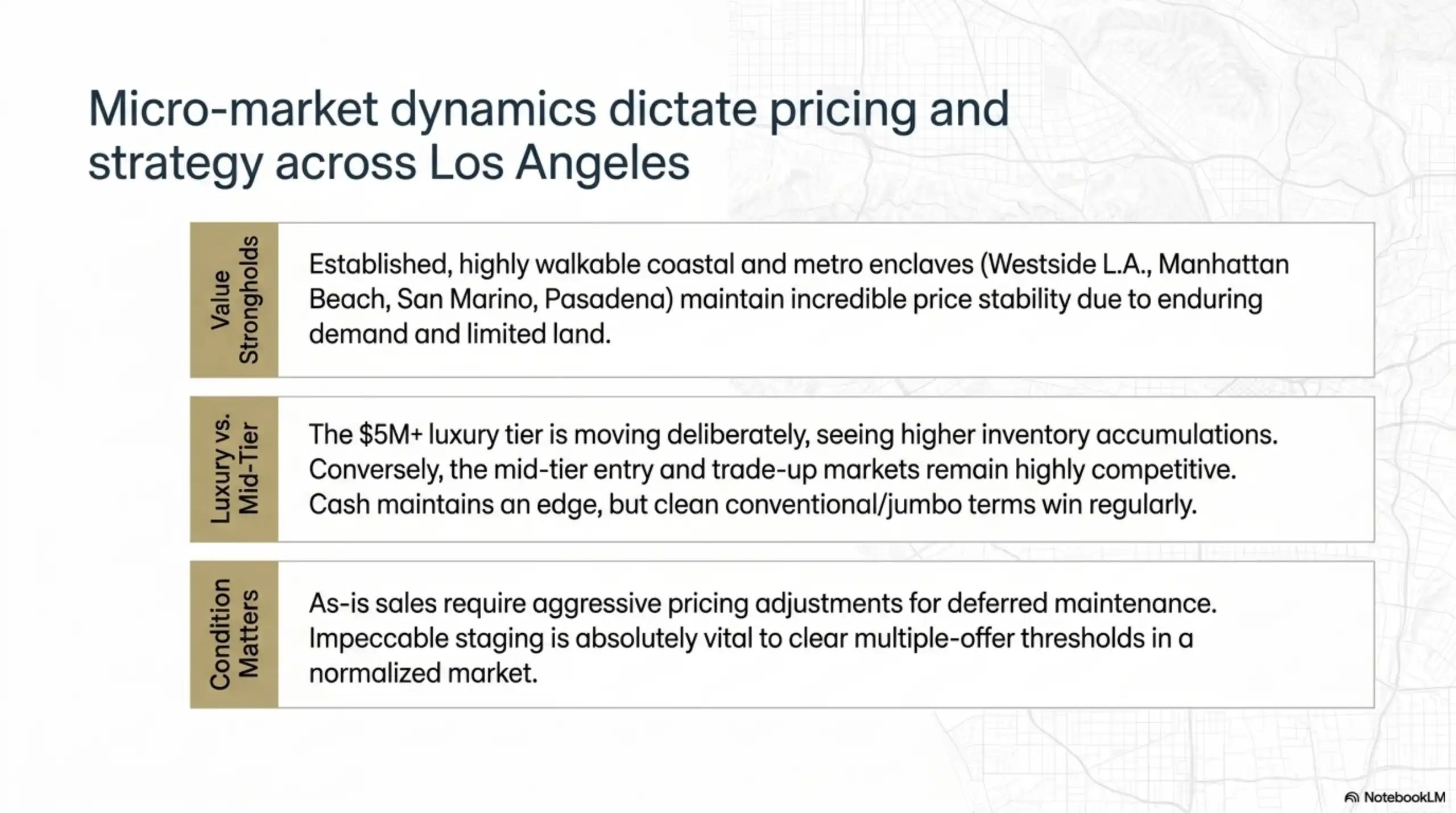
Established luxury and highly walkable coastal or metropolitan enclaves—such as parts of Westside L.A., Santa Monica, Manhattan Beach, and highly rated school districts like San Marino or Pasadena—continue to showcase incredible price stability due to limited land and enduring demand.
7. What is a seller concession, and can I ask for one?
A seller concession is an agreement where the seller covers a portion of the buyer’s transaction costs. In today’s market, it is common to successfully negotiate for concessions to credit closing costs or buy down your mortgage interest rate.
8. Are cash buyers dominating the Los Angeles real estate market right now?
While cash buyers maintain an advantage in luxury tiers, conventional and jumbo loan buyers are successfully winning offers because sellers are placing greater value on realistic closing timelines and clean contract terms.
9. How does current luxury inventory compare to standard residential tiers?
The luxury market ($5M+) is moving at a more deliberate pace, seeing higher inventory accumulations and more pronounced price corrections, whereas the mid-tier entry and trade-up markets remain highly competitive due to persistent underlying demand.
10. Can I still sell my Los Angeles home “as-is”?
Yes, you can list a property “as-is.” However, you must price it accordingly to account for deferred maintenance. Buyers today are less willing to pay premium prices for homes requiring immediate capital expenditure.
11. What is a 2-1 interest rate buy-down, and how does it help me?
This is an incentive where the seller pays an upfront sum into an escrow account to lower the buyer’s mortgage interest rate by 2% in the first year and 1% in the second year, scaling to the permanent rate by year three. This provides significant short-term financial relief.
12. Are corporate investors pulling out of the Southern California market?
Institutional investors have modified their acquisition parameters due to higher capital costs, leaving more single-family inventory accessible to traditional primary-residence homebuyers.
13. How important is home staging in our current real estate climate?
Staging is absolutely vital. In a normalized market where buyers have choices, your property must look impeccable online and in person to command premium attention and clear multiple-offer thresholds.
14. How do I know what my specific Los Angeles neighborhood is doing?
Macro data will not help you. You need a hyper-local Comparative Market Analysis (CMA) detailing active, pending, and sold data within a half-mile radius of your home over the past 30 to 90 days.
15. What should my first step be if I want to buy or sell in the next year?
Your first step should be scheduling a dedicated strategy consultation. Gathering accurate data early allows you to align your financial planning, home preparation, and timing with the real dynamics of our local market.
Actionable Real Estate Strategies
Curious about what is genuinely happening down your street? Skip the automated online estimates. Request an individualized market analysis designed specifically for your property asset. 👉 Request Your Custom Hyper-Local Equity Audit

Melissa Menard REALTOR® | Compass
Los Angeles & Surrounding Areas
📞 310.729.9726 | DRE# 01858710
📧 melissa@melissamenardhomes.com
🌐 www.MelissaMenardHomes.com
Disclaimer: The information provided in this post is for educational purposes only and does not constitute financial, legal, or investment advice. Market conditions are subject to change. Please consult with a qualified professional regarding your specific real estate needs and local Fair Housing regulations.