


So, you’ve looked at the landscape of 2026 and decided this isn’t the year you sign on the dotted line. Maybe you’re watching the Federal Reserve, which recently held the target range at 3.50% to 3.75% in March 2026, or perhaps you’re keeping an eye on the California Association of REALTORS® (C.A.R.) forecast, which projects mortgage rates to settle around 6.0% this year with a slow drift toward the 5% range by 2027.
Whatever the reason, I want to challenge one common misconception: Deciding not to sell now does not mean you should stop your home-selling journey.
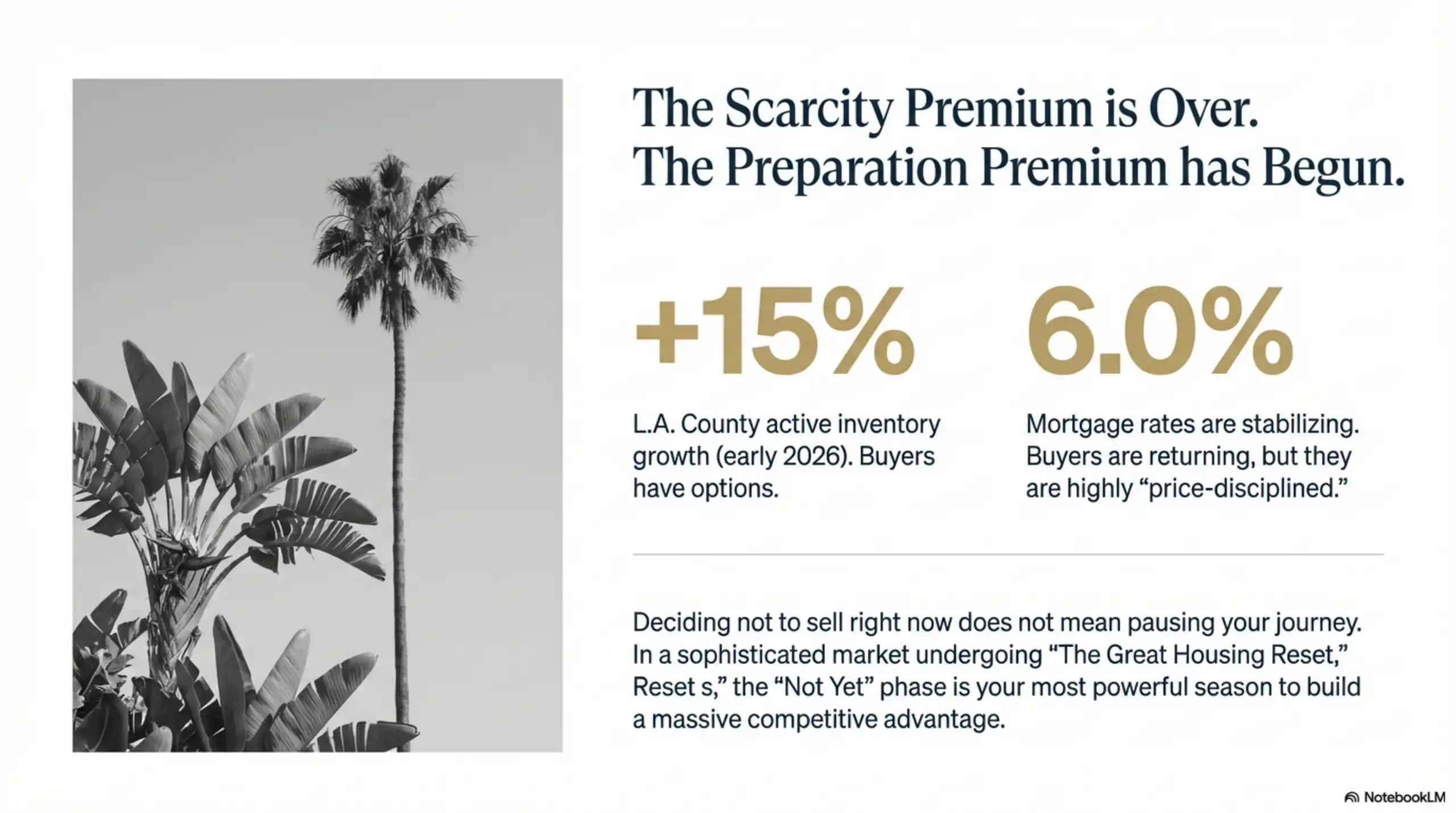
In a market as sophisticated and competitive as Los Angeles, from the coastal enclaves of the Westside to the historic pockets of Eagle Rock, the “Not Yet” phase is actually your most powerful season. It is the time to build a massive competitive advantage. According to recent data, L.A. County inventory has risen nearly 15% year-over-year as of early 2026. This means the “scarcity premium” is evolving into a market that rewards preparation over luck.
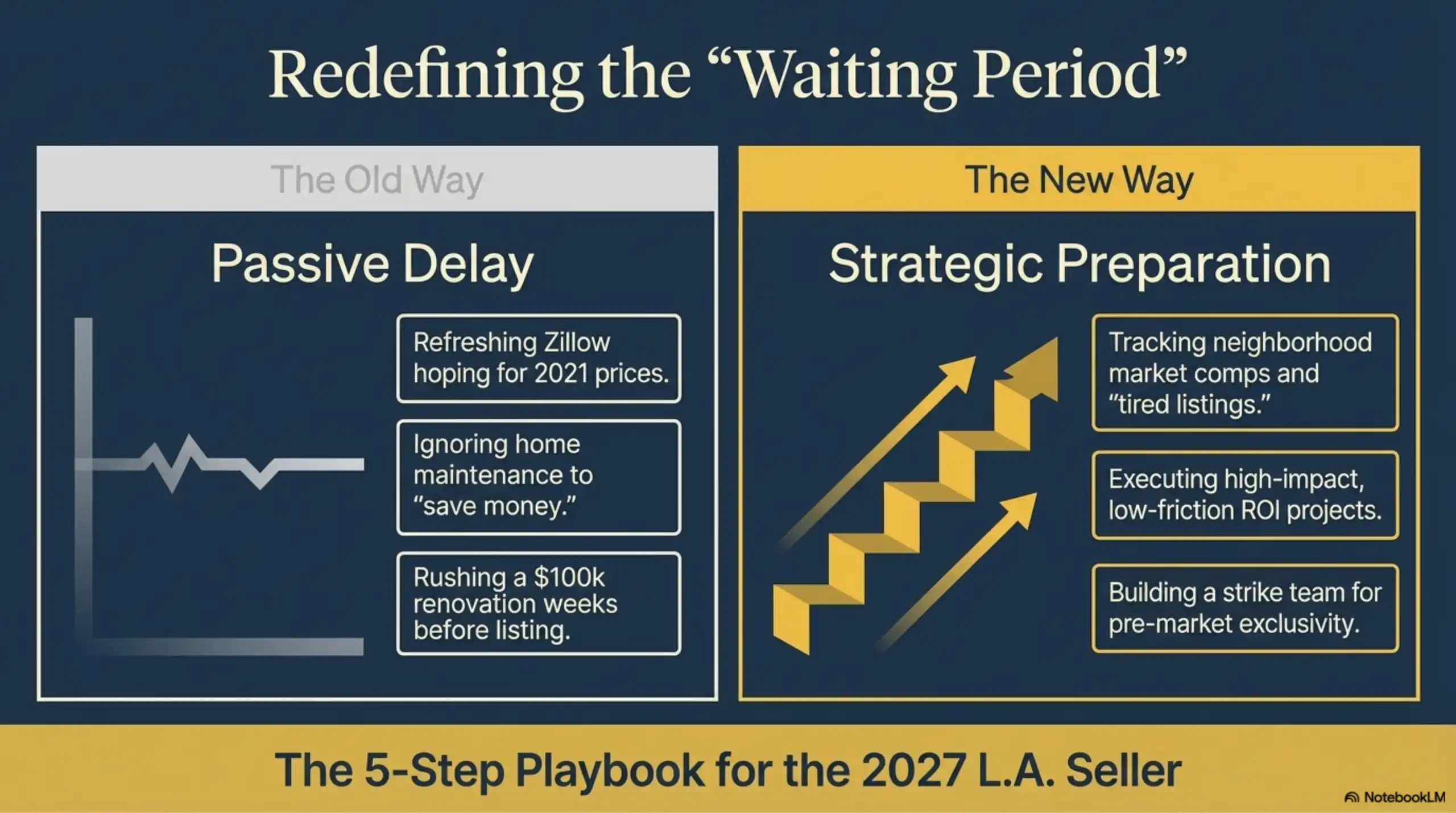
FAST FACTS: The 2026–2027 Seller’s “Not Yet” Strategy
- The 6.0% Pivot: With rates stabilizing near 6%, buyers are return-to-market, but they are more “price-disciplined” than in years past.
- Inventory Growth: L.A. active listings are up significantly from the 2022 lows, meaning your home must stand out aesthetically and mechanically.
- The Equity Audit: Use this year to track your “Net Proceeds” in real-time, accounting for L.A.’s specific tax landscape (including updated Measure ULA thresholds).
- The ROI Filter: Focus on “High-Impact, Low-Friction” updates. In 2026, L.A. buyers prioritize “turnkey” over “fixer-upper” due to high labor costs.
- Micro-Market Fluency: Watch “Sale-to-List” ratios in your specific zip code; the Westside is currently seeing more resilience than inland markets.
Step 1: Conduct a “Live” Equity Audit
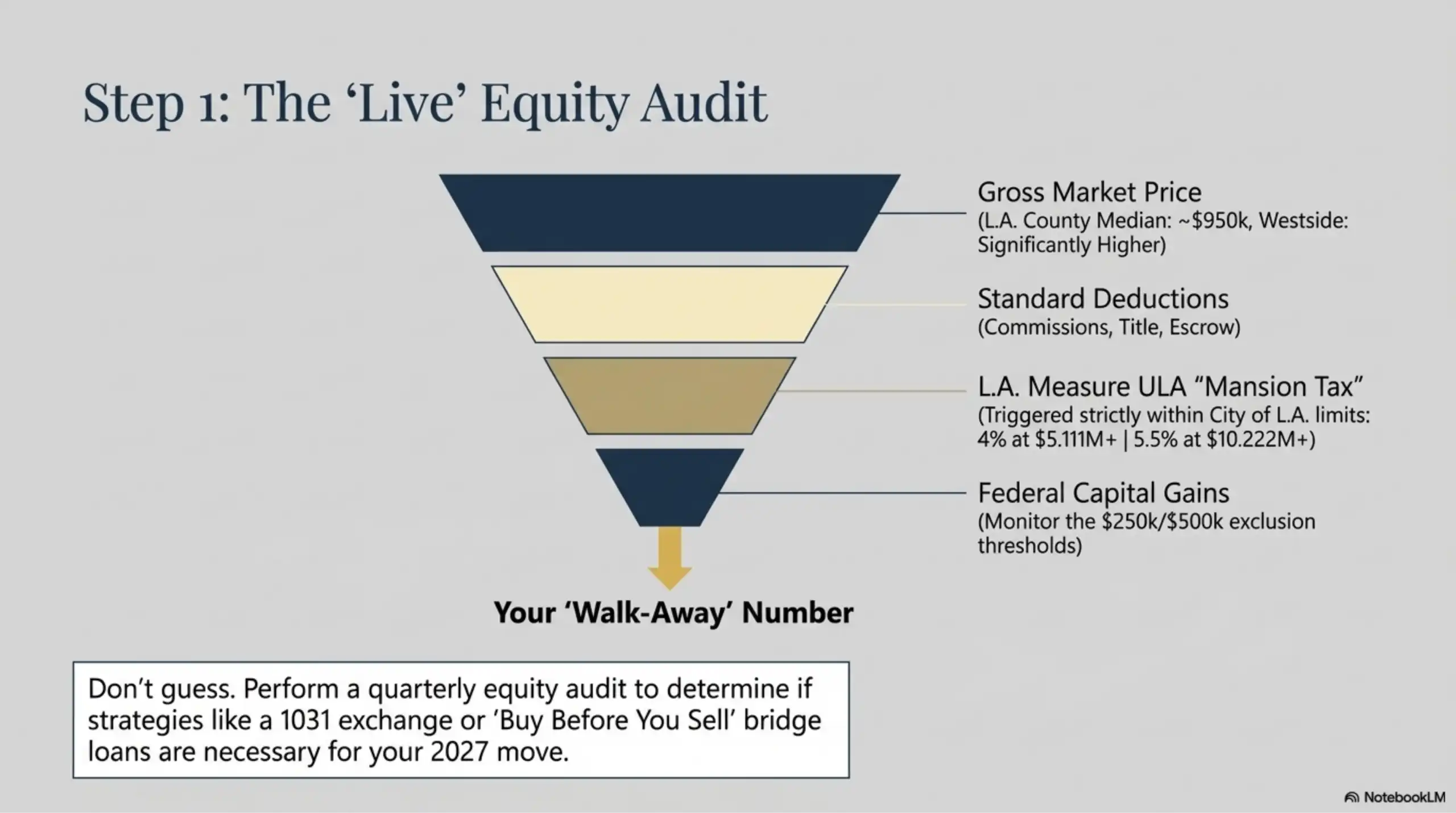
In Los Angeles, what your home is “worth” and what you “take home” are two very different numbers. Between the City of L.A. ULA “Mansion Tax” (which applies to properties over $5M) and standard closing costs, your net sheet needs a surgical review.
The Action: Don’t guess. Perform a quarterly equity audit.
The Goal: Calculate your “Walk-Away” number after commissions, title, escrow, and potential capital gains taxes. If you’ve lived in your home for decades, you may be crossing the $250k/$500k federal exclusion threshold. Knowing this now allows you to consult with a tax professional to see if 1031 exchanges or other strategies are viable for your 2027 move.
Step 2: The “Neighborhood Anthropologist” (Seller Edition)

When you aren’t in a rush to sell, you have the luxury of being a spy. You need to see what your future competition looks like before you’re in the ring with them.
The Action: Visit open houses in your immediate neighborhood every month.
The Ritual: Don’t just look at the finishes; look at the vibe.
- Sunday at 2:00 PM: How many people are actually walking through?
- The “Turn-Off” Factor: Note the things that make you want to leave a neighbor’s house (peeling paint, pet odors, outdated lighting).
- The “Hero” Feature: What is the one thing every buyer in your area is buzzing about? Is it an ADU? A drought-tolerant landscape? A dedicated home office?
Step 3: Execute “Low-Friction” ROI Projects
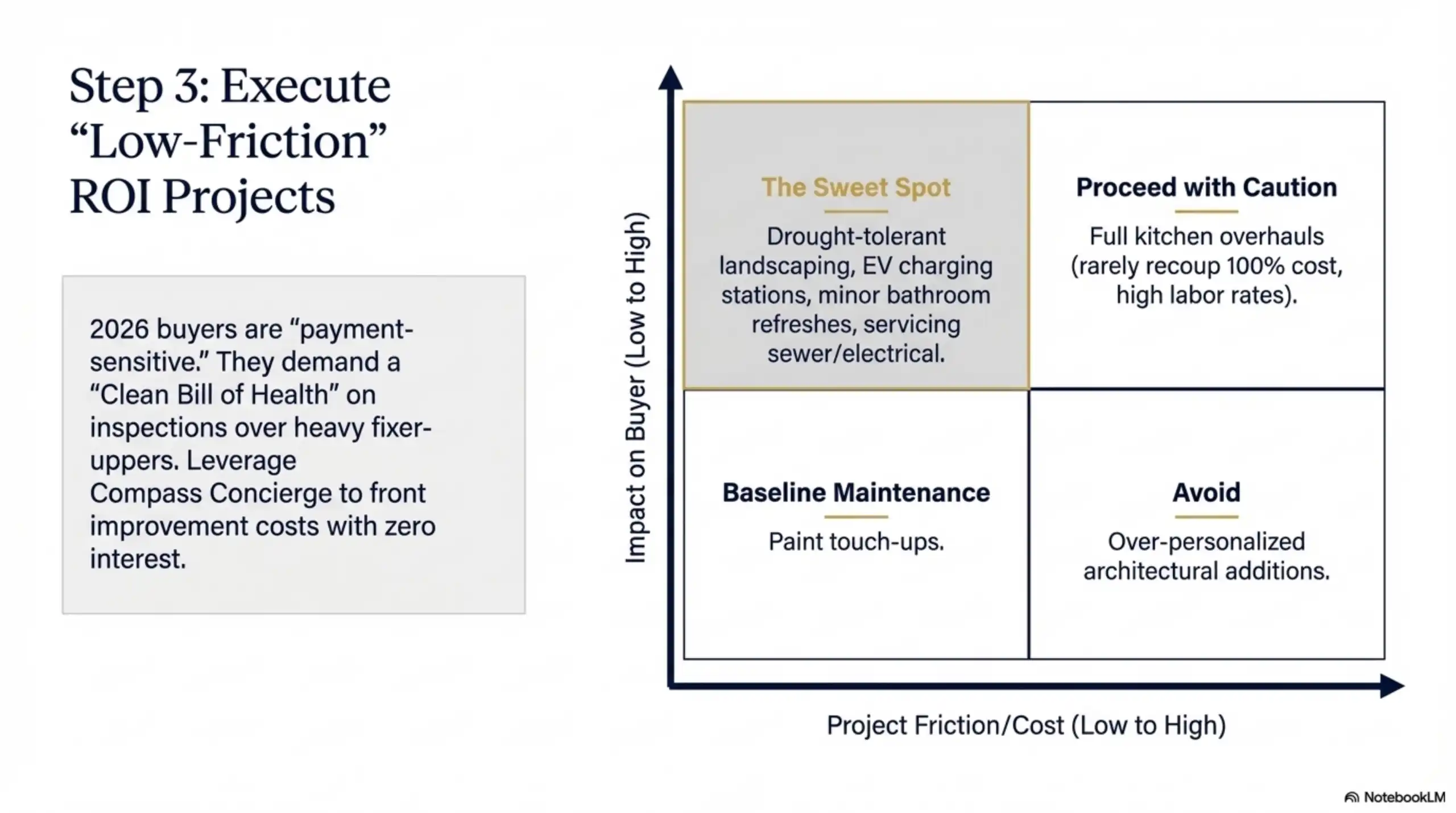
The biggest mistake L.A. sellers make is spending $100k on a kitchen remodel three weeks before listing. You don’t get to enjoy it, and you rarely recoup 100% of the cost.
The Action: Use the “Not Yet” year to tackle projects that increase marketability without a massive price tag.
The Pro Tip: In the 2026/2027 market, buyers are “payment-sensitive.” They don’t want to buy a house that needs a new roof or HVAC within two years. Use this time to service the “boring” stuff—sewer lines, electrical panels, and drainage. A “Clean Bill of Health” on a home inspection is the ultimate leverage in a balanced market.
Step 4: Track “Tired Listings” & Market Comps
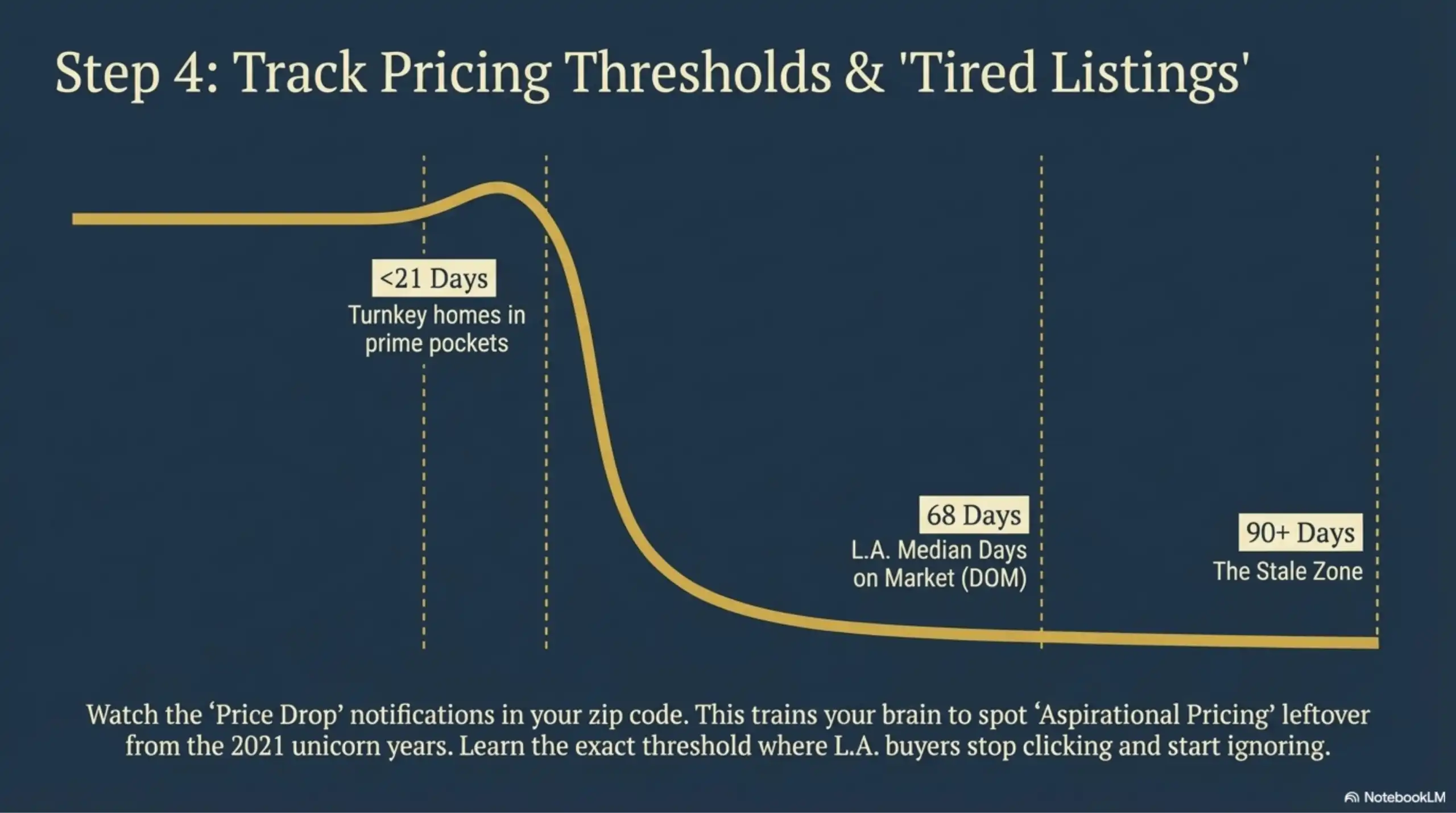
As of April 2026, the median Days on Market (DOM) in Los Angeles is hovering around 68 days. Some homes sell in a week; others sit until they feel “stale.”
The Action: Watch the “Price Drop” notifications in your zip code.
The Goal: This trains your brain to spot “Aspirational Pricing.” Many sellers are still mentally stuck in the “unicorn years” of 2021. By watching these “tired listings,” you learn the exact threshold where L.A. buyers stop clicking and start ignoring.
Step 5: Build Your “Strike Team”
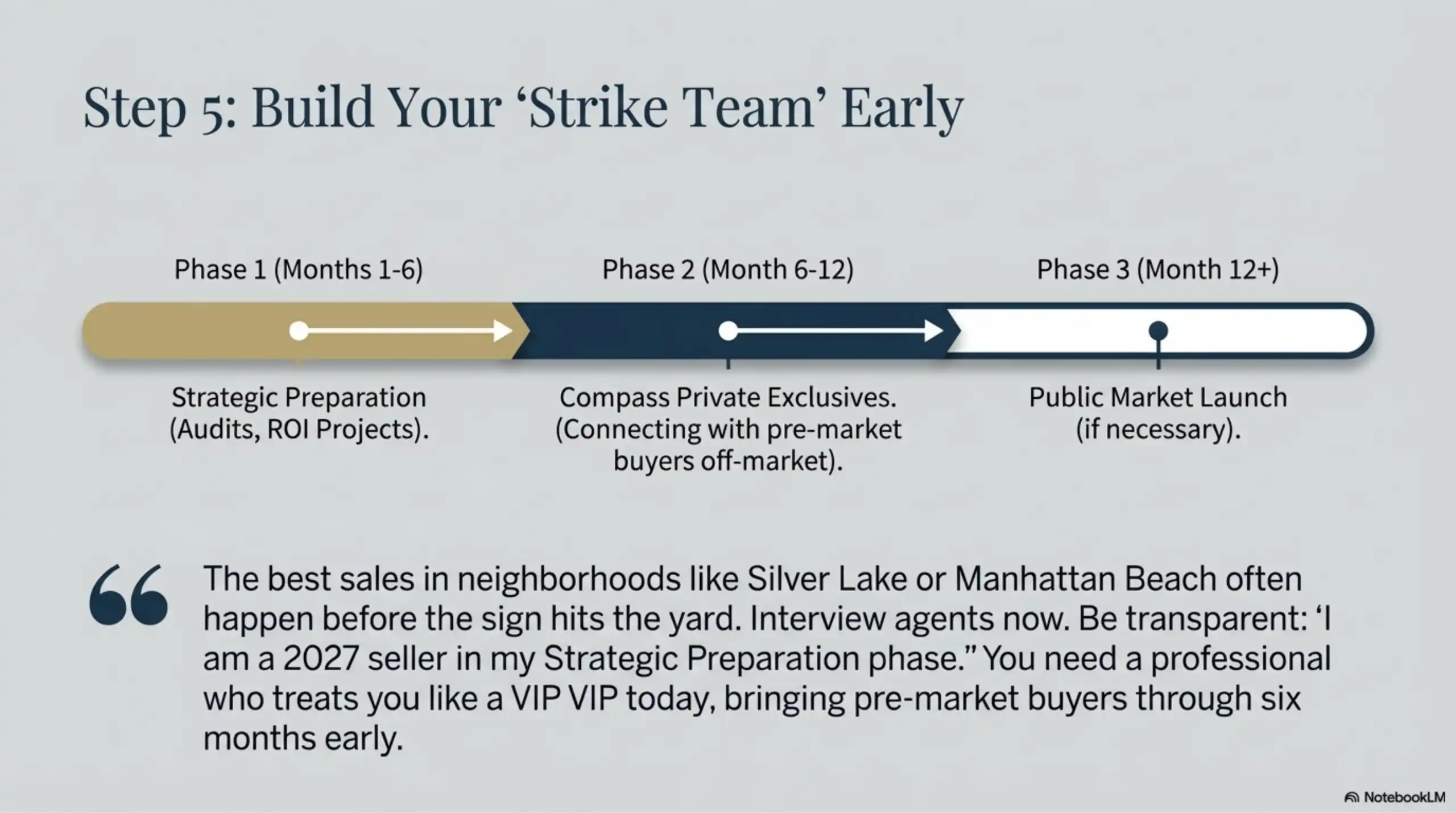
The best sales in neighborhoods like Silver Lake or Manhattan Beach often happen before the sign even hits the yard. These are “Compass Private Exclusives” or off-market “pocket” deals.
The Action: Interview agents now. Be transparent. Tell them: “I am a 2027 seller. I am currently in my ‘Strategic Preparation’ phase.”
The Goal: You want the professional who treats you like a VIP today, not just when you’re ready to sign a listing agreement. That is the person who will bring “pre-market” buyers through your home six months early.
Frequently Asked Questions (FAQ)
- Is it better to sell now while inventory is still relatively low, or wait for 2027?
Inventory is rising (up ~15% in early 2026). Waiting for 2027 may mean more competition, but if rates continue to ease toward 5.5%–5.9%, the buyer pool will be significantly larger. - What are the tax implications of selling a high-value home in Los Angeles?
Beyond federal capital gains, remember Measure ULA. Thresholds are adjusted annually; for 2026, the 4% tax generally triggers at $5.1M+. Always check the current year’s adjusted threshold.
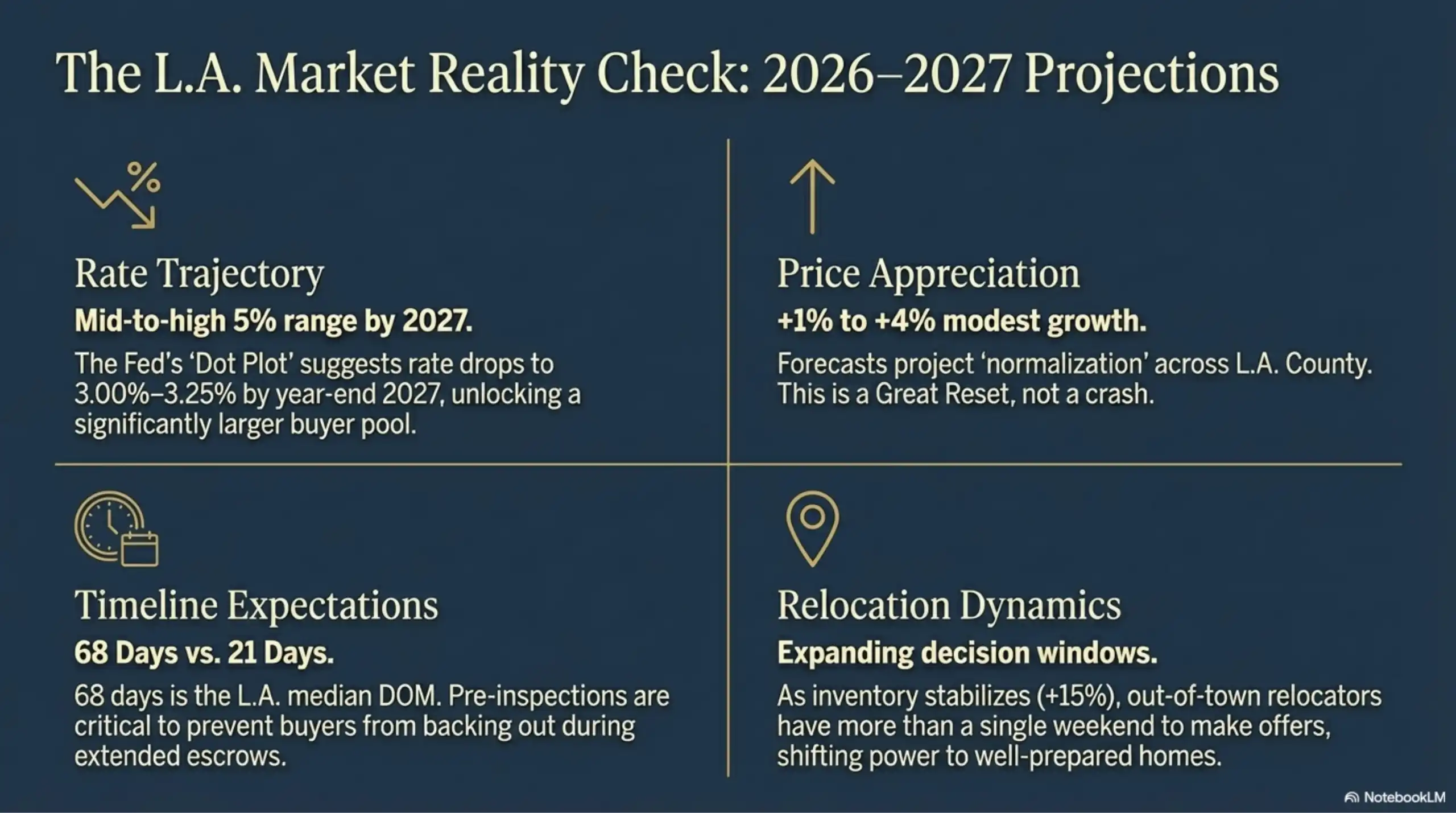
- Will L.A. home prices drop significantly by 2027?
Most forecasts (C.A.R., Zillow) project “normalization”—modest appreciation around 1%–4%. We are in “The Great Housing Reset,” not a crash. - Should I fix up my home or sell it “as-is” to a developer?
With high construction costs in 2026, developers are picky. You often net more by doing “light cosmetic” staging to appeal to a family. - How do I handle the “Lock-In” effect if I have a 3% mortgage rate?
We look at “Bridge Loans” or “Buy Before You Sell” programs. Use this year to see if your current home can be a high-performing rental. - What is the current median home price in L.A.?
As of early 2026, the L.A. County median listing price is approximately $950,000, though micro-markets like the Westside remain significantly higher. - Are interest rates expected to hit 5% in 2027?
The Fed’s “Dot Plot” as of March 2026 suggests the Fed Funds rate could fall to 3.00%–3.25% by year-end 2027, which typically correlates to mortgage rates in the mid-to-high 5% range. - What is the “Mansion Tax” threshold today?
For the 2025-2026 cycle, it is $5,111,000 for the 4% tax and $10,222,000 for the 5.5% tax. - How long does it take to sell a home in L.A. right now?
The average is 68 days, but “turnkey” homes in prime pockets still go in under 21 days. - What ROI projects are best for L.A. in 2026?
Drought-tolerant landscaping, EV charging stations, and minor bathroom refreshes. - Does Compass have a program to help with repairs?
Yes, Compass Concierge allows you to front the cost of home improvements with no interest. - Should I get a pre-inspection?
Yes. In a 60+ day DOM market, you want to eliminate any reason for a buyer to back out during escrow. - Is the “Mansion Tax” everywhere in L.A.?
No, it only applies to properties within the City of Los Angeles limits (not Santa Monica, Beverly Hills, or West Hollywood). - Is 2027 a good year for relocators?
Yes, as inventory stabilizes, relocators will have more than a weekend to make a decision. - How do I start a strategy session?
Simply reach out for a custom equity audit (details below).
Schedule a Strategy Call for your 2027 Move
Melissa Menard REALTOR® | Compass
Los Angeles & Surrounding Areas
📞 310.729.9726 | DRE# 01858710
📧 melissa@melissamenardhomes.com
🌐 www.MelissaMenardHomes.com
Disclaimer: The information provided in this post is for educational purposes only and does not constitute financial, legal, or investment advice. Market conditions are subject to change. Please consult with a qualified professional regarding your specific real estate needs and local Fair Housing regulations.