
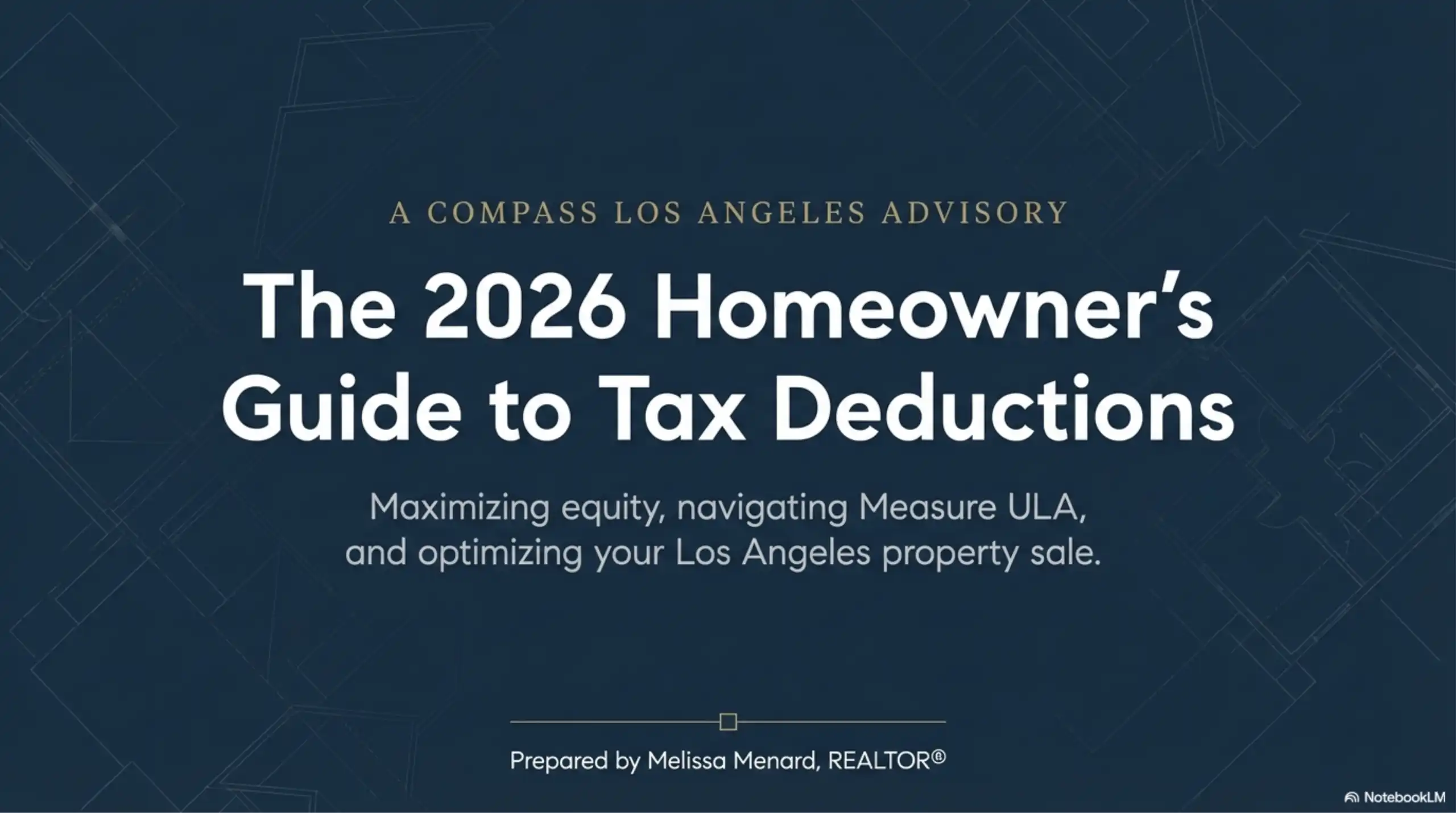
Selling a home in Los Angeles is a sophisticated financial maneuver. As we move through March 2026, the rules of the game have evolved. If you sold your property in 2025, those figures are hitting your tax return right now. If you are planning a sale in the coming months, you are navigating a landscape where “Mansion Tax” thresholds have adjusted and federal SALT (State and Local Tax) caps have undergone a historic shift.
In L.A.’s high-value market, your “profit” can easily exceed standard exemptions. Protecting your equity requires a meticulous understanding of what the IRS and the California Franchise Tax Board (FTB) allow you to keep.
Source Data & Reference: Realtor.com: Homeowners Guide to Taxes & Selling
________________________________
FAST FACTS: 2026 Tax Filing & Selling Insights
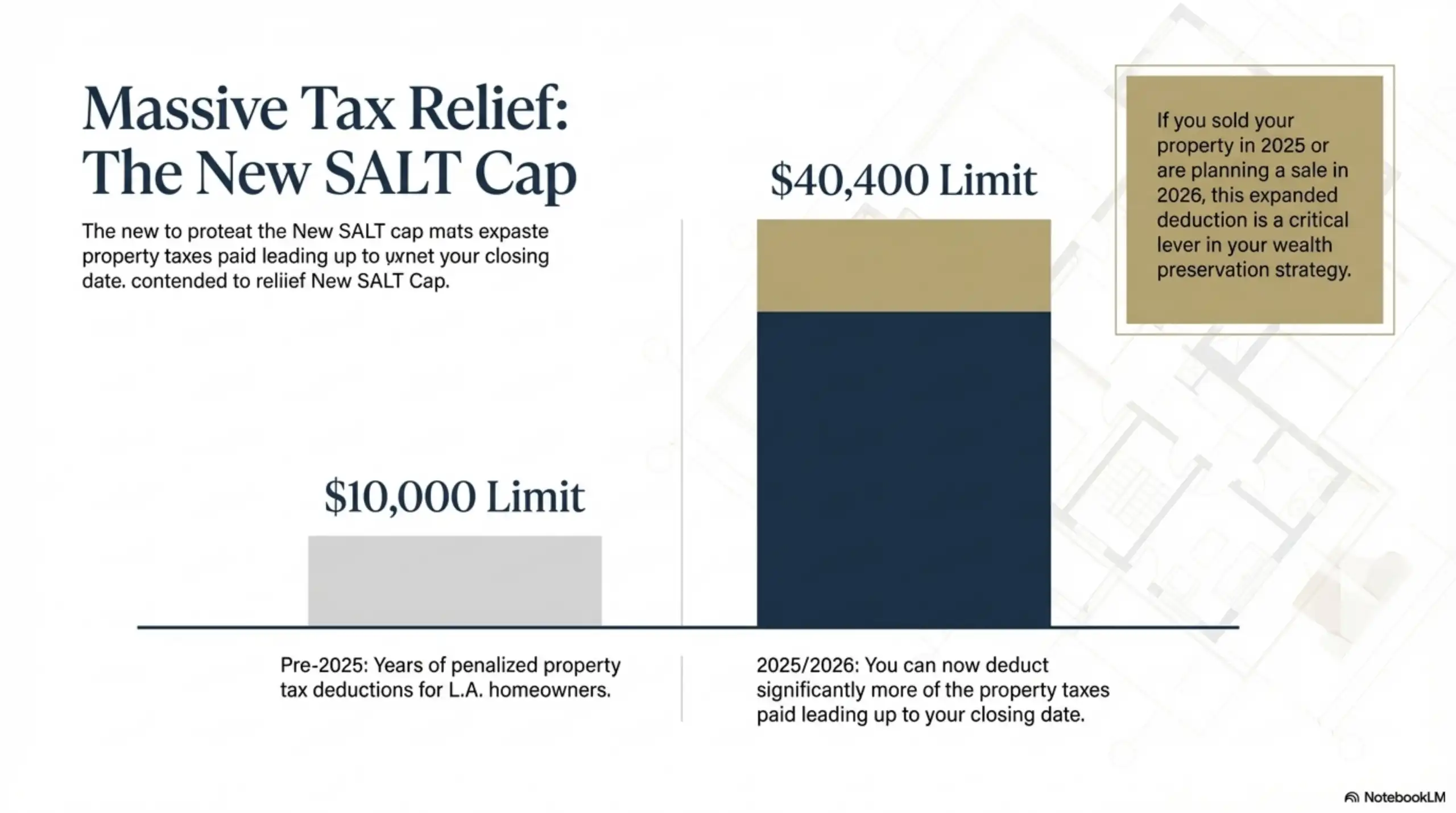
The $40,400 SALT Cap:
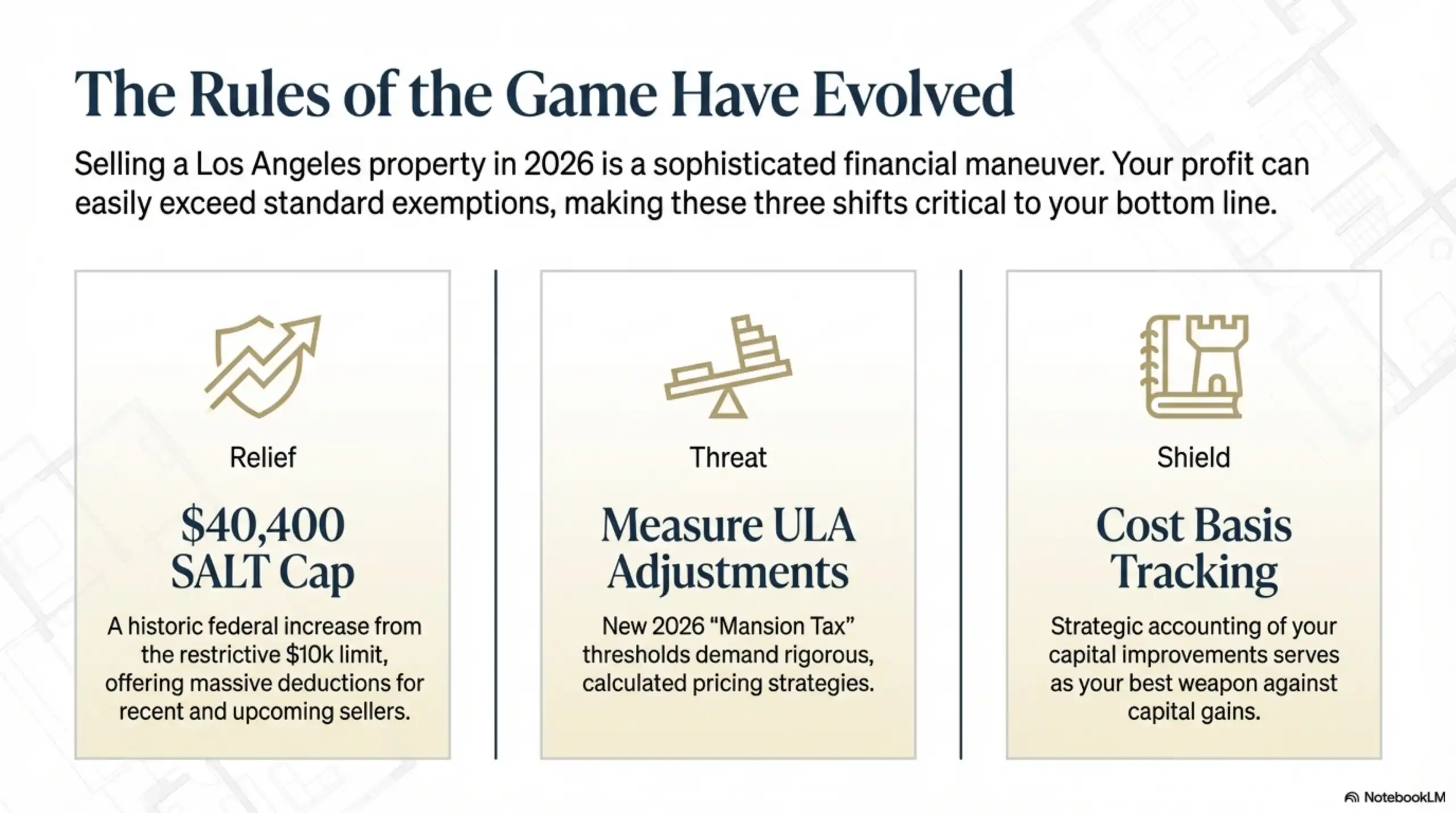
A major 2026 update—the SALT deduction cap has increased to $40,400 for the 2025/2026 tax years, providing massive relief for L.A. property owners compared to the old $10,000 limit.
Measure ULA (Current Thresholds):
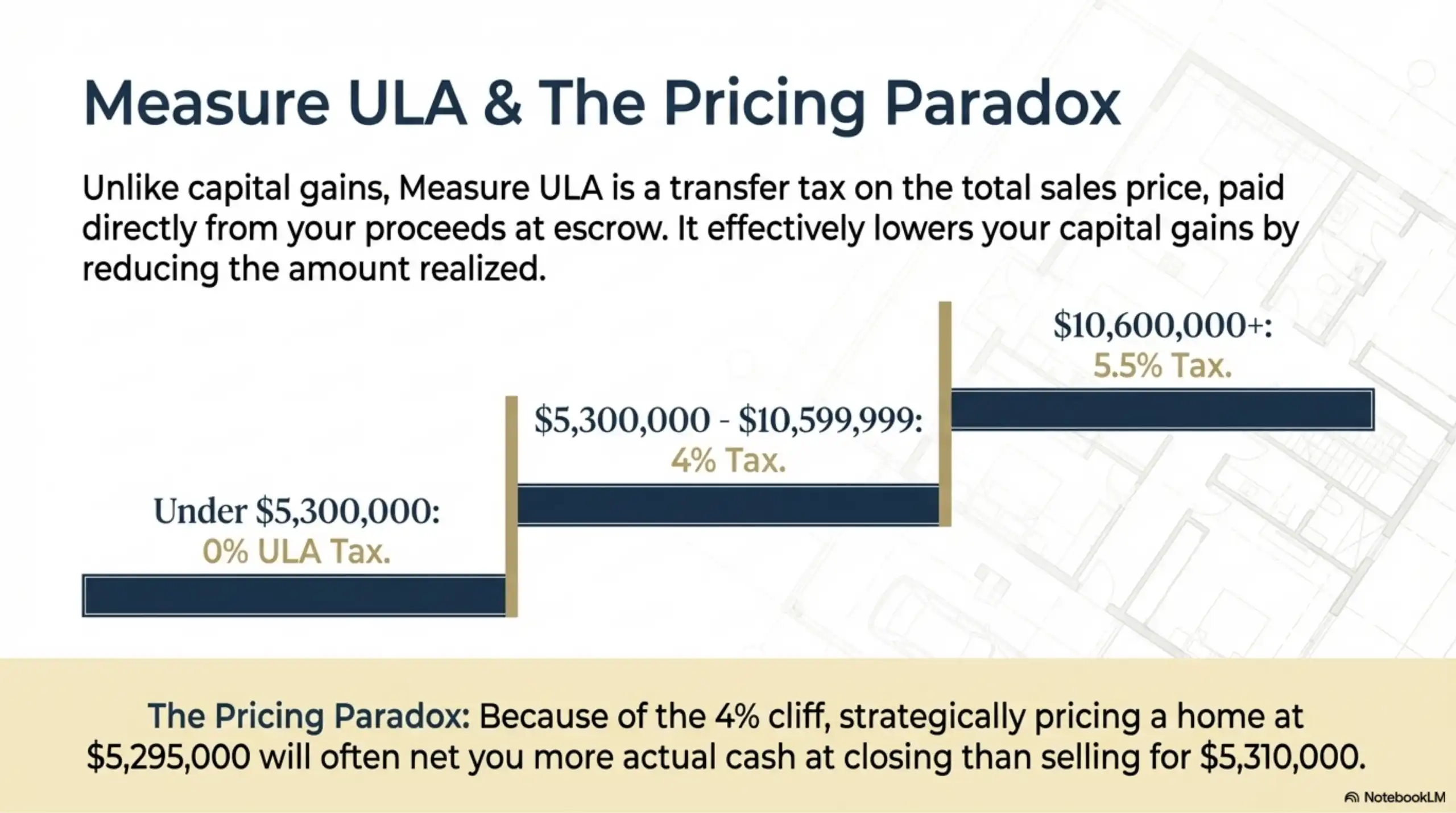
The L.A. City “Mansion Tax” thresholds for 2026 are $5,300,000 (4% rate) and $10,600,000 (5.5% rate).
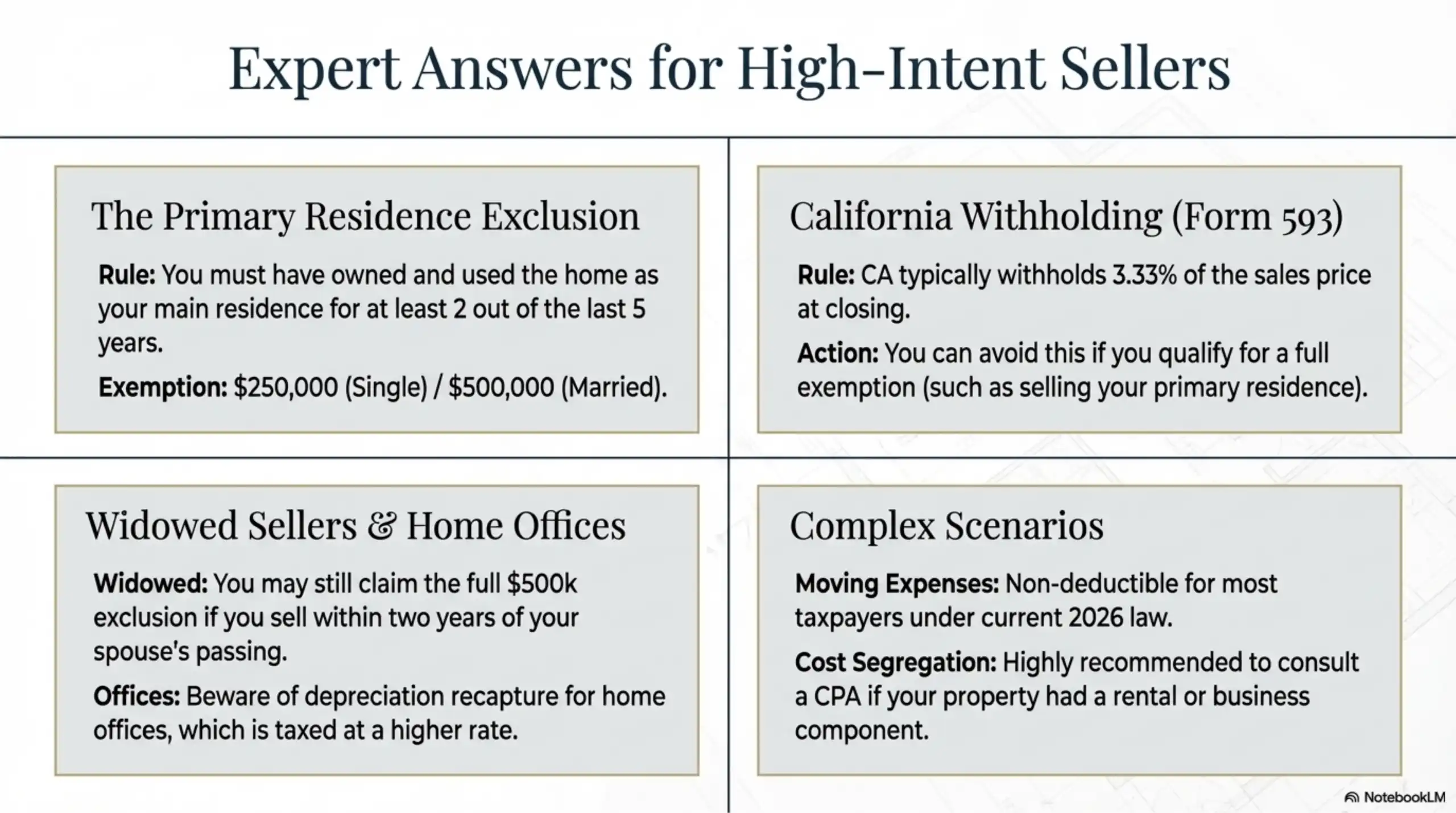
Primary Residence Exclusion:
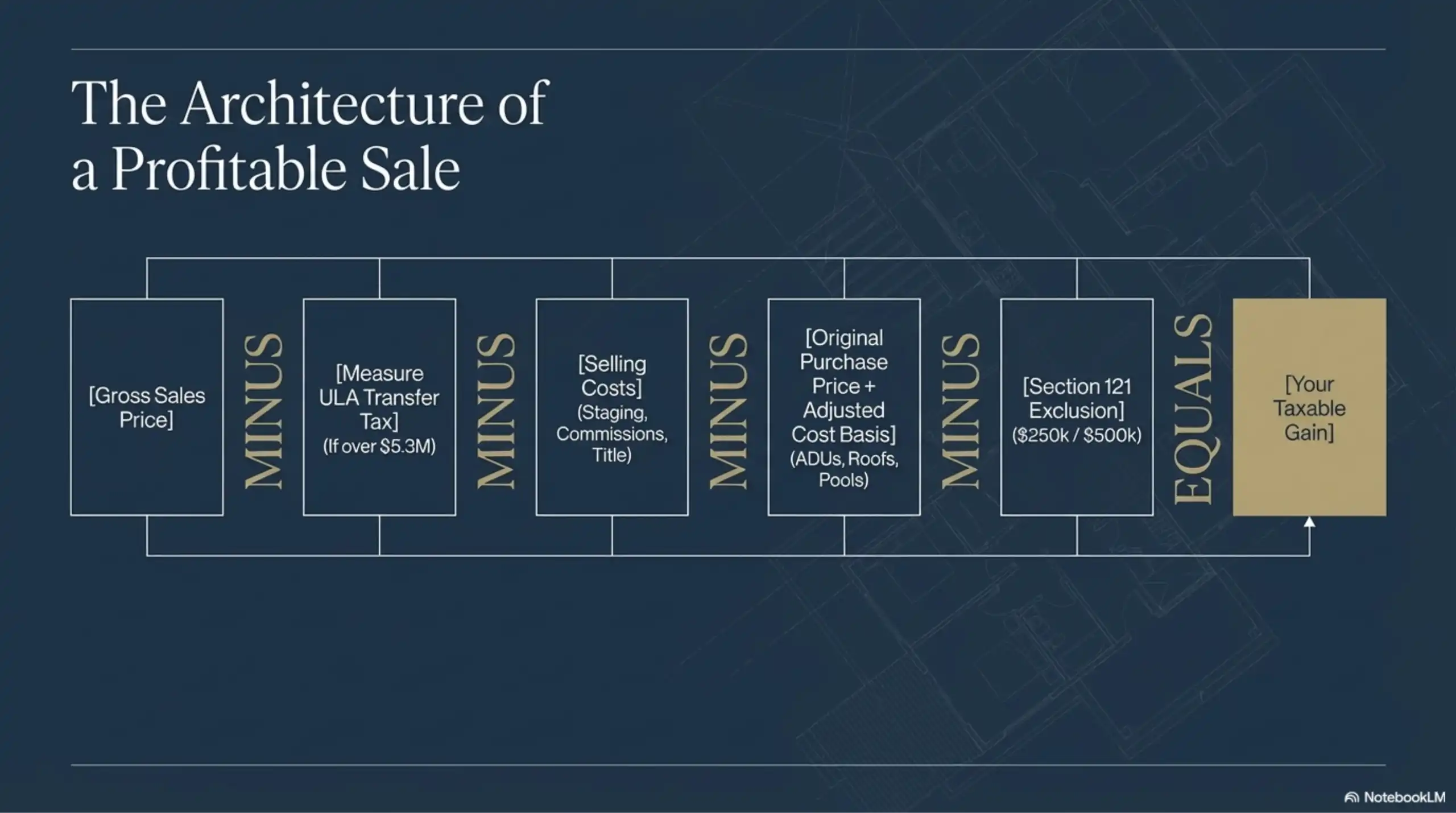
The Section 121 exclusion remains at $250,000 (Single) / $500,000 (Married).
Cost Basis Tracking:
In 2026, every receipt for capital improvements (ADUs, HVAC, luxury remodels) is a direct weapon against capital gains tax.
Deductible Selling Costs:
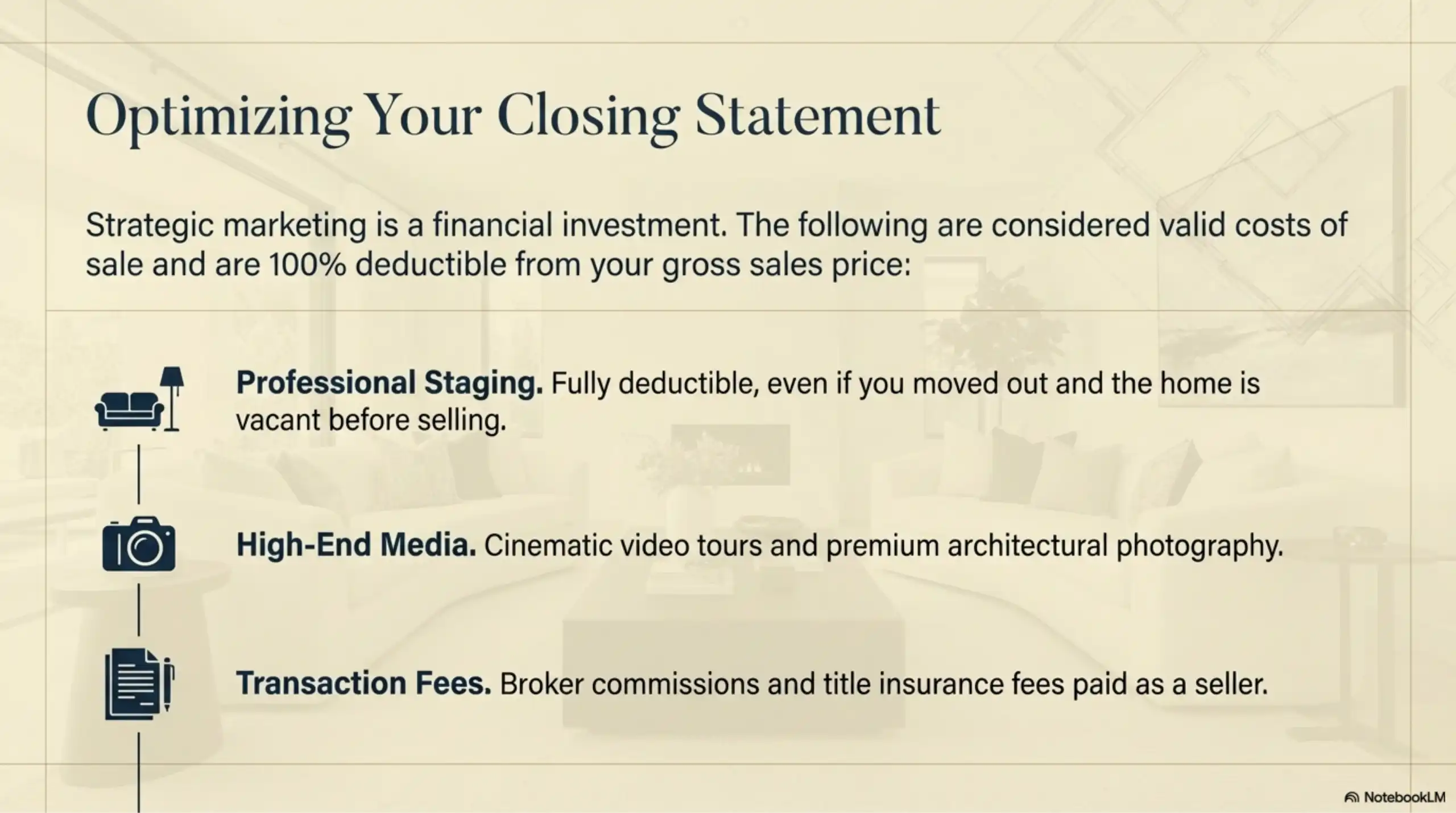
Professional staging, cinematic video tours, and broker commissions are 100% deductible from your gross sales price.
________________________________
The 2026 L.A. Context: New Relief and Familiar Hurdles
For years, Los Angeles homeowners were penalized by the $10,000 SALT cap. However, as you file your taxes in 2026 for a home sold in 2025, you can now benefit from the expanded $40,400 SALT deduction (thanks to the “One Big Beautiful Bill” Act adjustments). This allows you to deduct significantly more of the property taxes paid leading up to your closing date.
Adjusting Your Cost Basis: The Equity Protector
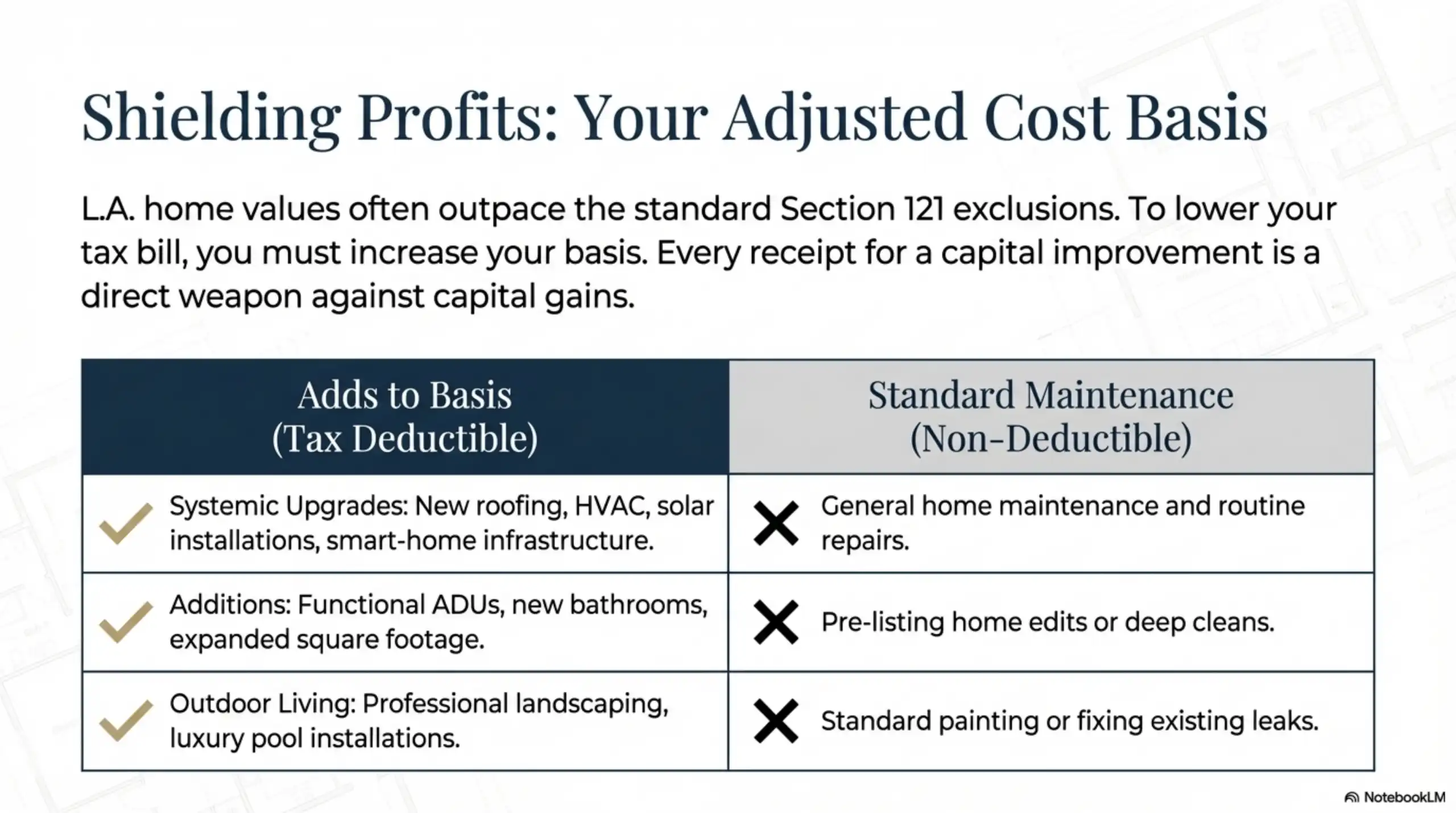
Because L.A. home values often double within a decade, many sellers find that the $500,000 exclusion doesn’t cover their entire gain. To lower your tax bill, you must increase your Adjusted Cost Basis.
What counts in 2026?
Systemic Upgrades:
New roofing, solar panel installations (note: some credits expire after 2025, so basis tracking is vital), and smart-home infrastructure.
Additions:
Adding a bathroom or a functional ADU (Accessory Dwelling Unit).
Outdoor Living:
Professional landscaping and pool installations—standard for L.A. luxury.
Note:
General maintenance (painting or fixing a leak) does not add to your basis.
The “Mansion Tax” (Measure ULA) Reality
If your property is within the City of Los Angeles limits, the ULA tax is a major consideration for 2026 transactions. Unlike capital gains, this is a transfer tax on the total sales price.
$5,300,000 – $10,599,999: 4% tax.
$10,600,000+: 5.5% tax.
As a seller, this tax is generally paid out of your proceeds at escrow. Understanding this threshold is critical for pricing strategy—selling for $5,295,000 may actually net you more than selling for $5,310,000 after the tax is applied.
________________________________
FAQ: 2026 High-Intent Seller Questions
1. I sold in late 2025; what is my filing deadline?
Your federal and state tax returns are due April 15, 2026.
2. Is the $40,400 SALT deduction officially in effect?
Yes, for the tax year 2025 (filed in 2026), the cap was raised significantly from the previous $10,000.
3. Does Measure ULA apply if I sell my home for $5.1 million?
No, the current 2026 threshold for the 4% tax starts at $5,300,000.
4. Can I deduct staging if I moved out before the house sold? Yes. Staging a vacant home to make it more marketable is a deductible selling expense.
5. How does the IRS define “Primary Residence” in 2026?
You must have owned and used the home as your main residence for at least 2 out of the last 5 years.
6. Can I deduct the cost of my pre-listing “Home Edit” or deep clean?
Generally, cleaning and “refreshing” are considered maintenance and are not deductible.
7. Are ADU construction costs deductible?
They are added to your cost basis, which reduces your taxable profit when you sell.
8. What is the CA withholding tax (Form 593)?
California typically withholds 3.33% of the sales price unless you qualify for a full exemption (e.g., primary residence).
9. Can I deduct mortgage interest paid in 2025 on my 2026 return?
Yes, mortgage interest remains deductible on the first $750,000 of debt for most homeowners.
10. Do I pay tax on the “Mansion Tax” itself?
The ULA tax is treated as a reduction in the “amount realized,” effectively lowering your capital gains.
11. Can I use the $500k exclusion if I’m widowed?
If you sell within two years of your spouse’s death, you may still qualify for the full $500,000 exclusion.
12. Are title insurance fees deductible?
Yes, the fees you pay for title insurance as a seller are considered costs of sale.
13. What if I used part of my L.A. home as a home office?
You may have to “recapture” depreciation taken for that office space, which is taxed at a higher rate.
14. Are moving expenses deductible in 2026?
No, moving expenses remain non-deductible for most taxpayers under current law.
15. Should I get a “Cost Segregation” study for a high-end residential sale?
If the property had a rental or business component, a study may be beneficial. Consult your CPA.
________________________________
Ready to Strategize Your 2026 Move?
The Los Angeles market demands a blend of high-end aesthetics and rigorous financial planning. Don’t leave your equity to chance. Whether you’re calculating your 2025 gains or prepping for a 2026 listing, let’s ensure your transition is seamless.
Schedule a Strategy Call with Melissa OR Request a Custom Equity Audit of Your Property

Melissa Menard REALTOR® | Compass
Los Angeles & Surrounding Areas
310.729.9726 | DRE# 01858710
melissa@melissamenardhomes.com
www.MelissaMenardHomes.com
Disclaimer: The information provided in this post is for educational purposes only and does not constitute financial, legal, or investment advice. Market conditions are subject to change. Please consult with a qualified professional regarding your specific real estate needs and local Fair Housing regulations.